Introduction
This explanation of accounting basics will introduce you to some basic accounting principles, accounting concepts, and accounting terminology. Once you become familiar with some of these terms and concepts, you will feel comfortable navigating through the explanations, quizzes, quick tests, video training, and other features on AccountingCoach.com.
Some of the basic accounting terms that you will learn include revenues, expenses, assets, liabilities, income statement, balance sheet, and statement of cash flows. You will become familiar with accounting debits and credits as we show you how to record transactions. You will also see why two basic accounting principles, the revenue recognition principle and the expense recognition or matching principle, assure that the company’s:
- Income statement reports the company’s profitability during the stated period of time
- Balance sheet reports the company’s assets and liabilities as of midnight of the balance sheet date
In this explanation of accounting basics, and throughout all of the free materials and the PRO materials, we will often omit some accounting details and complexities in order to present clear and concise explanations. This means that you should always seek professional advice for your specific circumstances.
WATCH NOW
Advance Your Career with Our PRO Training
A Story for Relating to Accounting Basics
We will present the basics of accounting through a story of a person starting a new business. The person is Joe Perez—a savvy man who sees the need for a parcel delivery service in his community. Joe has researched his idea and has prepared a business plan that documents the viability of his new business.
Joe has also met with an attorney to discuss the form of business he should use. Given his specific situation, they concluded that a corporation will be best. Joe decides that the name for his corporation will be Direct Delivery, Inc. The attorney also advises Joe on the various permits and government identification numbers that will be needed for the new corporation.
Joe is a hard worker and a smart man, but admits he is not comfortable with matters of accounting. He assumes he will use some accounting software, but wants to meet with a professional accountant before making his selection. He asks his banker to recommend a professional accountant who is also skilled in explaining accounting to someone without an accounting background. Joe wants to understand the financial statements and wants to keep on top of his new business. His banker recommends Marilyn, an accountant who has helped many of the bank’s small business customers.
At his first meeting with Marilyn, Joe asks her for an overview of accounting, financial statements, and the need for accounting software. Based on Joe’s business plan, Marilyn sees that there will likely be thousands of transactions each year. She states that accounting software will allow for the electronic recording, storing, and retrieval of those many transactions. Accounting software will permit Joe to generate the financial statements and other reports that he will need for running his business.
Joe seems puzzled by the term transaction, so Marilyn gives him five examples of transactions that Direct Delivery, Inc. will need to record:
- Joe will start his business by investing some of his personal money, and in exchange will receive shares of Direct Delivery’s common stock.
- Direct Delivery will need to buy a sturdy, dependable delivery vehicle.
- The business will begin earning fees and billing clients for delivering their parcels.
- The business will be collecting the fees that were earned.
- The business will incur expenses in operating the business, such as a salary for Joe, expenses associated with the delivery vehicle, advertising, etc.
With thousands of such transactions in a given year, Joe is smart to start using accounting software right from the beginning. Accounting software will generate sales invoices and accounting entries simultaneously, prepare statements for customers with no additional work, write checks, automatically update accounting records, etc.
By getting into the habit of entering all of the day’s business transactions into his computer, Joe will be rewarded with fast and easy access to the specific information needed to make sound business decisions. Marilyn tells Joe that recording transactions is useful, reliable, and informative. She has worked with other small business owners who think it is enough to simply “know” their company made $30,000 during the year (based on a couple of numbers from the beginning of the year and the end of the year). Those are the people who start off on the wrong foot and end up in Marilyn’s office looking for financial advice.
If all of Direct Delivery’s transactions are entered into its computer, good accounting software will allow Joe to print his financial statements with a click of a button. In the following pages Marilyn will explain the content and purpose of three of a company’s five financial statements:
- Income Statement
- Balance Sheet
- Statement of Cash Flows
The financial statements not discussed are:
Income Statement
Marilyn points out that an income statement will show how profitable Direct Delivery has been during the time interval shown in the statement’s heading. This period of time might be a week, a month, three months, five weeks, or a year—Joe can choose whatever time period he deems most useful.
The reporting of profitability generally involves two things:
- The amount that was earned (revenues)
- The expenses necessary to earn the revenues
As you will see next, the term revenues is not the same as receipts, and the term expenses involves more than the checks written.
A. Revenues
The main revenues for Direct Delivery are the fees it earns for delivering parcels. Under the accrual basis of accounting (as opposed to the less-preferred cash method of accounting), revenues are recorded when they are earned, not when the company receives the money. Recording revenues when they are earned is the result of one of the basic accounting principles known as the revenue recognition principle.
For example, if Joe delivers 1,000 parcels in December for $4 per delivery, he has earned fees totaling $4,000 for that month. He sends invoices to his clients for these fees and his terms require that his clients must pay by January 10. Even though his clients won’t be paying Direct Delivery until January 10, the accrual basis of accounting requires that the $4,000 be recorded as December revenues, since that is when the delivery work actually took place. When invoices are prepared and revenues are recorded, the software will also record the amount in the asset account Accounts Receivable.
Assuming Joe receives the $4,000 worth of payment checks from his customers in January, the $4,000 of receipts will not be considered to be January revenues. (The revenues were already reported as revenues in December when they were earned.) This $4,000 of receipts will be recorded in January and will increase the company’s Cash and will reduce the amount in Accounts Receivable.
B. Expenses
Now Marilyn turns to the second part of the income statement—expenses. The December income statement should show expenses incurred during December regardless of when the company actually paid for the expenses. For example, if Joe hires someone to help him with December deliveries and Joe agrees to pay him $500 on January 3, that $500 expense needs to be shown on the December income statement. (The date that the $500 is paid out isn’t the date of the expense.) What matters is when the work was done—when the expense was incurred—and in this case, the work was done in December. The $500 expense is counted as a December expense even though the money will not be paid out until January 3. The recording of expenses with the related revenues is associated with another basic accounting principle known as the matching principle or expense recognition principle.
Marilyn explains to Joe that showing the $500 of wages expense on the December income statement will result in a matching of the cost of the labor used to deliver the December parcels with the revenues from delivering the December parcels. This matching principle is very important in measuring just how profitable a company was during a given time period.
Marilyn is delighted to see that Joe already has an intuitive grasp of this basic accounting principle. In order to earn revenues in December, the company had to incur some business expenses in December, even if the expenses won’t be paid until January. Other expenses to be matched with December’s revenues include gas for the delivery van, advertising spots on the radio, and perhaps others.
Joe asks Marilyn to provide another example of a cost that wouldn’t be paid in December, but would have to be shown/matched as an expense on December’s income statement. Marilyn uses the Interest Expense on borrowed money as an example. She asks Joe to assume that on December 1 Direct Delivery borrows $20,000 from Joe’s aunt and the company agrees to pay his aunt 6% per year in interest, or $1,200 per year. This interest of $1,200 is to be paid on December 1 of each year.
Now even though the interest is being paid out to his aunt only once per year as a lump sum, Joe can see that in reality, a little bit of that interest expense is incurred each and every day he’s in business. If Joe is preparing monthly income statements, Joe should report one month of Interest Expense on each month’s income statement. The amount that Direct Delivery will incur as Interest Expense will be $100 per month for 12 months ($20,000 x 6% ÷ 12). In other words, Joe needs to match $100 of interest expense with each month’s revenues. The interest expense is considered a cost that is necessary to earn the revenues shown on the income statements.
C. Net Income
Marilyn explains to Joe that the income statement is a bit more complicated than what she just explained, but for now she just wants Joe to learn some basic accounting concepts and some of the accounting terminology. Marilyn does make sure, however, that Joe understands one simple yet important point: an income statement, does not report the cash coming in—rather, its purpose is to (1) report the revenues earned by the company’s efforts during the accounting period, and (2) report the expenses incurred by the company during the same period. The purpose of the income statement is to show a company’s profitability during the specified period of time. The difference (or “net“) between the revenues and expenses for Direct Delivery is often referred to as the bottom line and it is labeled as either Net Income or Net Loss.
Marilyn also informs Joe that the income statement amounts might be different from the income tax return amounts since the tax rules can be different from the accounting profession’s rules. For now, Joe should focus on the accounting rules and work to make his business profitable.
Note: To learn more about the income statement, visit our Explanation and Quiz for this topic.
Balance Sheet – Assets
Marilyn moves on to explain the balance sheet, a financial statement that reports the amount of a company’s (A) assets, (B) liabilities, and (C) stockholders’ (or owner’s) equity at a specific point in time (or instant or moment). Since the balance sheet reflects a specific point in time rather than a period of time, Marilyn likes to refer to the balance sheet as a “snapshot” of a company’s financial position at the end of the accounting period. For example, if a balance sheet is dated December 31, the amounts on the balance sheet reflect the account balances after all transactions up to midnight on December 31 have been recorded.
(A) Assets
Assets are things or resources that a company owns. Joe readily understands this—off the top of his head he names things such as the company’s vehicle, its cash in the bank, all of the supplies he has on hand, and the dolly he uses to help move the heavier parcels. Marilyn nods and shows Joe how these are reported in accounts entitled Vehicles, Cash, Supplies, and Equipment. She mentions one asset Joe hadn’t considered—Accounts Receivable. If Joe delivers parcels, but isn’t paid immediately for the delivery, the amount owed to Direct Delivery is an asset known as Accounts Receivable.
Prepaids
Marilyn brings up another less obvious asset—the unexpired portion of prepaid expenses. Suppose Direct Delivery pays $1,200 on December 1 for a six-month insurance premium on its delivery vehicle. That divides out to be $200 per month ($1,200 ÷ 6 months). Between December 1 and December 31, $200 of insurance premium is “used up” or “expires”. The expired amount is reported as Insurance Expense on December’s income statement. Joe asks Marilyn where the remaining $1,000 of unexpired insurance premium is reported. On the December 31 balance sheet, Marilyn tells him, in an asset account Prepaid Insurance.
Other examples of things that might be paid for before they are used include supplies and annual dues to a trade association. The portion that expired in the current accounting period is listed as an expense on the income statement; the part that has not yet expired is listed as an asset on the balance sheet.
Marilyn assures Joe that he will soon see a link between the income statement and balance sheet, but for now she continues with her explanation of assets.
Cost Principle and Conservatism
Joe learns that the cost principle requires each of his company’s assets to be recorded at its cost at the time of purchase. Further, the recorded cost will not be increased if the fair market value increases to more than its cost. (One exception involves an investment in common stock that is actively traded on a major stock exchange. In that situation, the investment’s cost will be adjusted to the stock’s current market value.)
Although accountants do not increase the value of most assets, they might decrease an asset’s value as a result of a concept known as conservatism. For example, after a few months in business, Joe may decide that he can earn additional revenues by carrying an inventory of packing boxes to sell. Let’s say that Direct Delivery purchased 100 boxes for $10 each. Since the time when Joe bought them, however, the price of boxes has been cut by 40% and at today’s price he could purchase them for $6 each. If the net realizable value of his inventory is less than the original recorded cost, the principle of conservatism directs the accountant to report the lower amount as the asset’s value on the company’s balance sheet.
In short, the cost principle generally prevents assets from being reported at more than cost, while conservatism might require assets to be reported at less than their cost.
Depreciation
Joe also needs to know that the reported amounts on Direct Delivery’s balance sheet for assets used in the business such as equipment, vehicles, and buildings are routinely reduced by depreciation. Depreciation is required by the basic accounting principle known as the matching principle. Depreciation is used for assets whose life is not indefinite—equipment wears out, vehicles become too old and costly to maintain, buildings age, and some assets (like computers) become obsolete. Depreciation is the systematic allocation of the cost of the asset to Depreciation Expense (on the income statement) over its useful life.
As an example, assume that Direct Delivery’s used van has a useful life of five years and was purchased at a cost of $20,000. The accountant might match $4,000 ($20,000 ÷ 5 years) of Depreciation Expense with each year’s revenues for five years. Each year the carrying amount of the van will be reduced by $4,000. (The carrying amount—or “book value“—is reported on the balance sheet and it is the cost of the van minus the total depreciation since the van was acquired.) This means that after one year the balance sheet will report the carrying amount of the delivery van as $16,000, after two years the carrying amount will be $12,000, etc. After five years—the end of the van’s expected useful life—its carrying amount will be zero.
Joe wants to be certain that he understands what Marilyn is telling him regarding the assets on the balance sheet, so he asks Marilyn if the balance sheet is, in effect, showing what the company’s assets are worth. He is surprised to hear Marilyn say that the assets are not reported on the balance sheet at their worth (fair market value). Long-term assets (such as buildings, equipment, and furnishings) are reported at their cost minus the amounts already sent to the income statement as Depreciation Expense. As a result, a building’s market value may actually have increased since it was acquired, but the amount on the balance sheet has been consistently reduced as the accountant moved some of its cost to Depreciation Expense on the income statement in order to achieve the matching principle.
Another asset, Office Equipment, may have a fair market value that is less than or greater than the carrying amount reported on the balance sheet. (Accountants view depreciation as an allocation process—allocating the cost to expense in order to match the costs with the revenues generated by the asset, or with accounting periods in which the asset was used. Accountants do not consider depreciation to be a valuation process.) The asset Land is not depreciated, so it will appear at its original cost even if the land is now worth one hundred times more than its cost.
Short-term (current) asset amounts are likely to be close to their market values, since they tend to “turn over” in relatively short periods of time.
Marilyn cautions Joe that the balance sheet reports only the assets acquired (purchased) and only at the cost reported in the transaction. This means that a company’s reputation—as excellent as it might be—will not be listed as an asset. It also means that Jeff Bezos will not appear as an asset on Amazon.com’s balance sheet; Nike’s logo will not appear as an asset on its balance sheet; etc. Joe is surprised to hear this, since in his opinion these items are perhaps the most valuable things those companies have. Marilyn tells Joe that he has just learned an important lesson that he should remember when reading a balance sheet.
Balance Sheet – Liabilities and Stockholders’ Equity
(B) Liabilities
The balance sheet reports Direct Delivery’s liabilities at the final moment of the date shown in the heading of the balance sheet. Liabilities are obligations of the company; they are amounts owed to others as of the balance sheet date. Marilyn gives Joe some examples of liabilities: the loan he received from his aunt (Notes Payable or Loan Payable), the interest on the loan he owes to his aunt (Interest Payable), the amount he owes to the supply store for items purchased on credit (Accounts Payable), the wages he owes to employees (Wages Payable).
Another liability is the money received in advance of actually earning the money. For example, suppose that Direct Delivery enters into an agreement with one of its customers stipulating that the customer prepays $600 in return for the delivery of 30 parcels every month for 6 months. Assume Direct Delivery receives that $600 payment on December 1 for deliveries to be made between December 1 and May 31. Direct Delivery has a cash receipt of $600 on December 1, but it does not have revenues of $600 at this point. It will have revenues only when it earns them by delivering the parcels. On December 1, Direct Delivery will show that its asset Cash increased by $600, but it will also have to show that it has a liability of $600. (It has the obligation to deliver $600 of parcels within 6 months, or return the money.)
The liability account involved in the $600 received on December 1 is Unearned Revenue (or Deferred Revenues, Customer Deposits, etc.). Each month, as the 30 parcels are delivered, Direct Delivery will be earning $100. As a result, each month $100 will move from the liability Unearned Revenue to Service Revenues reported on the income statement.
(C) Stockholders’ Equity
If the company is a corporation, the third section of a corporation’s balance sheet is stockholders’ equity. (If the company is a sole proprietorship, it is owner’s equity.) The amount of stockholders’ equity is the difference (or residual) of assets minus liabilities. Stockholders’ equity is also the “book value” of the corporation.
Since the corporation’s assets are shown at cost or lower (and not at their market values) it is important that you do not associate the reported amount of stockholders’ equity with the market value of the corporation. (Hence, it is a poor choice of words to refer to stockholders’ equity as the corporation’s “net worth”.) To determine the estimated market value of a corporation, you should obtain the services of a professional familiar with valuing businesses.
Within the stockholders’ equity section you may see accounts such as Common Stock, Paid-in Capital in Excess of Par Value-Common Stock, Preferred Stock, Retained Earnings, Accumulated Other Comprehensive Income, Treasury Stock, and Current Year’s Net Income.
The account Common Stock will be increased when the corporation issues shares of its common stock in exchange for cash (or some other asset). Another stockholders’ account Retained Earnings will increase when the corporation earns a profit. There will be a decrease when the corporation has a net loss. This means that revenues will automatically cause an increase in stockholders’ equity and expenses will automatically cause a decrease in stockholders’ equity. This illustrates a link between a company’s balance sheet and income statement.
Retained Earnings (and Cash) will decrease when a corporation declares and pays a cash dividend to its stockholders.
Note: To learn more about the balance sheet, visit our Explanation and Quiz for this topic.
Statement of Cash Flows
The third financial statement that Joe should understand is the Statement of Cash Flows. This statement shows how Direct Delivery’s cash balance has changed during the time interval shown in the heading of the statement. This should be the same period of time as the income statement. Joe will be able to see at a glance the cash generated and used by his company’s operating activities, its investing activities, and its financing activities. Much of the information on this financial statement will come from Direct Delivery’s balance sheets and income statements.
Note: To learn more about the cash flow statement, visit our Explanation and Quiz for this topic.
The three financial reports that Marilyn introduced to Joe—the income statement, the balance sheet, and the statement of cash flows—represent just part of the valuable information that good accounting software will generate for business owners.
Marilyn now explains to Joe the basics of recording Direct Delivery’s transactions.
Double-Entry System
The field of accounting—both the older manual systems and today’s accounting software—is based on the 500-year-old accounting procedure known as double entry. Double entry is a simple yet powerful concept: each and every one of a company’s transactions will result in an amount recorded into at least two of the accounts in the accounting system. (The accounts are contained in what’s known as the general ledger.)
Chart of Accounts
To begin the process of setting up Joe’s accounting system, he will need to make a detailed listing of all the names of the accounts that Direct Delivery, Inc. might find useful for sorting and reporting transactions. This detailed listing is referred to as a chart of accounts. (Accounting software often provides sample charts of accounts for various types of businesses.)
As he enters his transactions, Joe will find the chart of accounts helpful in selecting the two (or more) accounts that are involved. Once Joe’s business begins, he may add more accounts to the chart of accounts, or delete accounts that are never used.
Basically, the chart of accounts and the accounts in the general ledger are arranged as follows:
Balance Sheet accounts:
Income Statement accounts:
Note: To learn more about the chart of accounts, visit our Explanation and Quiz for this topic.
To help Joe understand how this works, Marilyn illustrates the double-entry system with some sample transactions that Joe will likely encounter.
Sample Transaction #1
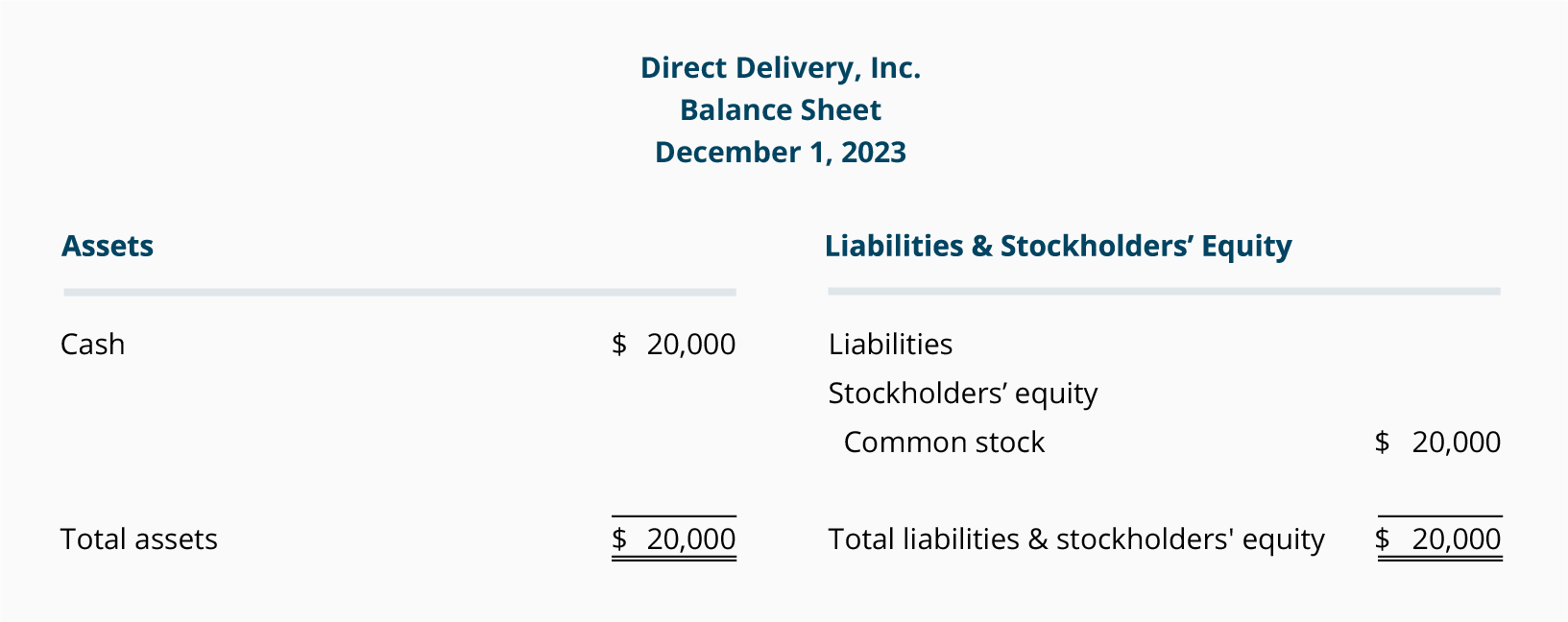
On December 1, 2025 Joe starts his business Direct Delivery, Inc. The first transaction that Joe will record for his corporation is his personal investment of $20,000 in exchange for 5,000 shares of Direct Delivery’s common stock. Direct Delivery’s accounting system will show an increase in its account Cash from zero to $20,000, and an increase in its stockholders’ equity account Common Stock by $20,000. Both of these accounts are balance sheet accounts. There are no revenues because no delivery fees were earned by the company, and there were no expenses.
After Joe enters this transaction, Direct Delivery’s balance sheet will look like this:

Marilyn asks Joe if he can see that the balance sheet is just that—in balance. Joe looks at the total of $20,000 on the asset side, and looks at the $20,000 on the right side, and says yes, of course, he can see that it is indeed in balance.
Marilyn shows Joe something called the basic accounting equation, which, she explains, is really the same concept as the balance sheet, it’s just presented in an equation format:

The accounting equation (and the balance sheet) should always be in balance.
Debits and Credits
Did the first sample transaction follow the double-entry system and affect two or more accounts? Joe looks at the balance sheet again and answers yes, both Cash and Common Stock were affected by the transaction.
Marilyn introduces the next basic accounting concept: the double-entry system requires that the same dollar amount of the transaction must be entered on both the left side of one account, and on the right side of another account. Instead of the word left, accountants use the word debit; and instead of the word right, accountants use the word credit. (The terms debit and credit are derived from Latin terms used 500 years ago.)
Here’s a Tip
Debit means left.
Credit means right.
Joe asks Marilyn how he will know which accounts he should debit—meaning he should enter the numbers on the left side of one account—and which accounts he should credit—meaning he should enter the numbers on the right side of another account. Marilyn points back to the basic accounting equation and tells Joe that if he memorizes this simple equation, it will be easier to understand the debits and credits.
Here’s a Tip
Memorizing the simple accounting equation will help you learn the debit and credit rules for entering amounts into the accounting records.
Let’s take a look at the accounting equation again:

Just as assets are on the left side (or debit side) of the accounting equation (the left side of the equal sign), the asset accounts in the general ledger have their balances on the left side. To increase an asset account’s balance, you put more on the left side of the asset account. In accounting jargon, you debit the asset account. To decrease an asset account balance you credit the account, that is, you enter the amount on the right side.
Just as liabilities and stockholders’ equity are on the right side (or credit side) of the accounting equation, the liability and equity accounts in the general ledger will normally have their balances on the right side. To increase the balance in a liability or stockholders’ equity account, you put more on the right side of the account. In accounting jargon, you credit the liability or the equity account. To decrease a liability or equity, you debit the account, that is, you enter the amount on the left side of the account.
As with all rules, there are a few exceptions, but Marilyn’s reference to the accounting equation may help you to learn whether an account should be debited or credited.
Since many transactions involve cash, Marilyn suggests that Joe memorize how the Cash account is affected when a transaction involves cash: if Direct Delivery receives cash, the Cash account is debited; when Direct Delivery pays cash, the Cash account is credited.
Here’s a Tip
When a company receives cash, the Cash account is debited.
When the company pays cash, the Cash account is credited.
Marilyn refers to the example of December 1. Since Direct Delivery received $20,000 in cash from Joe in exchange for 5,000 shares of common stock, one of the accounts for this transaction is Cash. Since cash was received, the Cash account will be debited.
In keeping with double entry, two (or more) accounts need to be involved. Because the first account (Cash) was debited, the second account needs to be credited. All Joe needs to do is find the right account to credit. In this case, the second account is Common Stock. Common stock is part of stockholders’ equity, which is on the right side of the accounting equation. As a result, it should have a credit balance, and to increase its balance the account needs to be credited.
Accountants indicate accounts and amounts using the following general journal format:

Accountants show the account and amount to be debited first. Then on the next line, the account to be credited is indented and the amount appears further to the right than the debit amount in the line above.
Accounting software has made the process of recording transactions so much easier that the general journal format is rarely needed. For instance, entries are often generated automatically when a check or sales invoice is prepared.
Sample Transaction #2
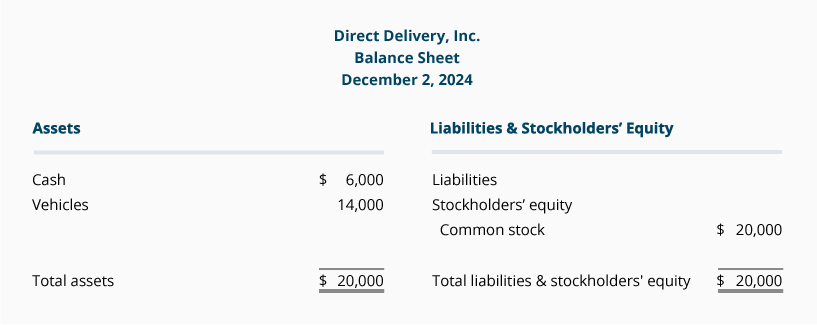
Marilyn illustrates for Joe a second transaction. On December 2, Direct Delivery purchases a used delivery van for $14,000 by writing a check for $14,000. The two accounts involved are Cash and Vehicles (or Delivery Equipment). When the check is written, the accounting software will automatically record the entry into these two accounts.
Marilyn explains to Joe what is happening within the software. Since the company pays $14,000, the asset account Cash is credited. (Accountants consider the checking account to be Cash, and the TIP you learned is that when cash is paid, you credit Cash.) So we know that the Cash account will be credited for $14,000 and we know the other account will have to be debited for $14,000. We need only identify the best account to debit. In this case we choose the asset account Vehicles (or Delivery Equipment) and the entry in the general journal format is:
After the vehicle transaction is recorded, the balance sheet will look like this:
Notice that the balance sheet and the accounting equation remain in balance:
As you can see in the balance sheet, the asset Cash decreased by $14,000 and another asset Vehicles increased by $14,000. Liabilities and stockholders’ equity were not involved and did not change.
Sample Transaction #3
The third sample transaction also occurs on December 2 when Joe contacts an insurance agent regarding insurance coverage for the vehicle Direct Delivery just purchased. The agent informs him that $1,200 will provide insurance protection for the next six months. Joe immediately writes a check for $1,200 and mails it to the insurance company.
In this transaction (and all transactions) there must be a minimum of two accounts involved—one (or more) of the accounts must be debited, and one (or more) must be credited.
Since a check is written, we know that one of the accounts involved is Cash. Since cash was paid, the Cash account will be credited. (Take another look at the last TIP.) While we have not yet identified the second account, what we do know for certain is that the second account will have to be debited.
At this point we have most of the entry—all we are missing is the name of the account to be debited:
We know the transaction involves insurance, and a quick look through the chart of accounts reveals two possibilities:
Prepaid Insurance (an asset account reported on the balance sheet) and Insurance Expense (an expense account reported on the income statement)
Assets include costs that are not yet expired (not yet used up), while expenses are costs that have expired (have been used up). Since the $1,200 payment is for an expense that will not expire in its entirety within the current month, it would be logical to debit the account Prepaid Insurance. (At the end of each month, when $200 has expired, $200 must be moved from Prepaid Insurance to Insurance Expense.)
The entry in the general journal format to record Direct Delivery’s payment is:
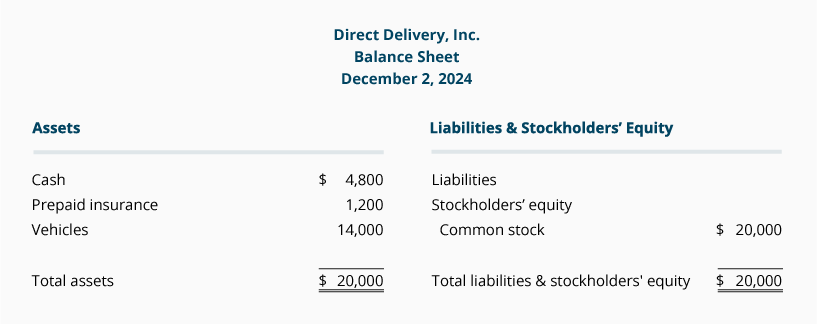
After the first three transactions have been recorded, the balance sheet will look like this:
Again, the balance sheet and the accounting equation are in balance and all of the changes occurred on the asset/left/debit side of the accounting equation. Liabilities and stockholders’ equity were not affected by the insurance transaction or the vehicle purchase.
Sample Transaction #4
The fourth transaction occurs on December 3, when a customer gives Direct Delivery a check for $10 to deliver two parcels on that day. Because of double entry, we know there must be a minimum of two accounts involved—one of the accounts must be debited, and one of the accounts must be credited.
Because Direct Delivery received $10, it must debit the account Cash. It must also credit a second account for $10. The second account will be Service Revenues, an income statement account. The reason Service Revenues is credited is because Direct Delivery earned $10 (not because it received $10). Recording revenues when they are earned results from a basic accounting principle known as the revenue recognition principle. The following tip reflects that principle.
Here’s a Tip
Revenue accounts are credited when the company earns a fee (or sells merchandise) regardless of whether cash is received at the time.
Here are the two parts of the transaction as they would look in the general journal format:
Sample Transaction #5
Let’s assume that on December 3 the company gets its second customer—a local company that needs to have 50 parcels delivered immediately. Joe’s price of $250 is very appealing, so Joe’s company is hired to deliver the parcels. The customer tells Joe to submit an invoice for the $250, and they will pay it within seven days.
Joe delivers the 50 parcels on December 3 as agreed, meaning that on December 3 Direct Delivery has earned $250. Therefore, the $250 is reported as revenues on December 3, even though the company did not receive any cash on that day. The effort needed to complete the job was done on December 3. (Depositing the check for $250 in the bank when it arrives seven days later is not considered to require any effort.)
Let’s identify the two accounts involved and determine which needs a debit and which needs a credit.
Because Direct Delivery has earned the fees, one account will be a revenue account, such as Service Revenues. (If you refer back to the last TIP, you will read that revenue accounts—such as Service Revenues—are usually credited.)
In the general journal format, here’s what we have identified so far:
We know that the unnamed account cannot be Cash because the company did not receive money on December 3. However, the company has earned the right to receive the money in seven days. The account title for the money that Direct Delivery has a right to receive for having provided the service is Accounts Receivable (an asset account).
Again, reporting revenues when they are earned results from the basic accounting principle known as the revenue recognition principle.
Sample Transaction #6
For simplicity, let’s assume that the only expense incurred by Direct Delivery so far was a fee to a temporary help agency for a person to help Joe deliver parcels on December 3. The temp agency fee is $80 and is to be paid by December 12.
Since Direct Delivery did not pay cash immediately, you cannot credit Cash. But because the company owes someone the money for its purchase, we say it has an obligation or liability to pay. Most accounts involved with obligations have the word “payable” in their name, and one of the most frequently used accounts is Accounts Payable. Also keep in mind that expenses are almost always debited.
The accounts and amounts for the temporary help are:
Here’s a Tip
Expenses are (almost) always debited.
Here’s a Tip
If a company does not pay cash immediately for an expense or for an asset, you cannot credit Cash. Because the company owes someone the money for its purchase, we say it has an obligation or liability to pay. The most common liability account involved in business obligations is Accounts Payable.
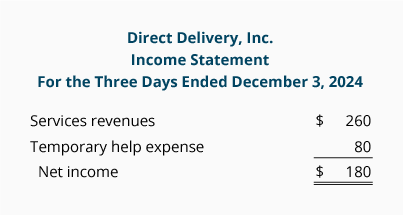
Revenues and expenses appear on the income statement as shown below:

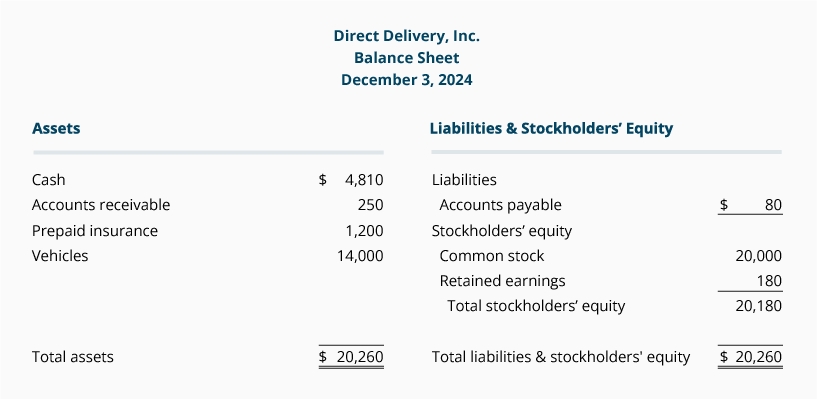
After the transactions through December 3 have been recorded, the balance sheet will look like this:

Notice that the year-to-date net income (bottom line of the income statement) increased stockholders’ equity by the same amount, $180. This connection between the income statement and balance sheet is important. For one, it keeps the balance sheet and the accounting equation in balance. Secondly, it demonstrates that revenues will cause the stockholders’ equity to increase and expenses will cause stockholders’ equity to decrease. After the end-of-the-year financial statements are prepared in a manual accounting system, you would see that the income statement accounts (revenue accounts and expense accounts) would be closed or zeroed out and their balances transferred into the Retained Earnings account. As a result, the revenue and expense accounts will start the new year with zero balances—allowing the company “to keep score” for the new year.
Marilyn suggested that perhaps this introduction was enough material for their first meeting. She wrote out the following notes, summarizing for Joe the important points of their discussion:
- When a company pays cash for something, the company will credit Cash and will have to debit a second account. Assuming that a company prepares monthly financial statements—
- If the amount is used up or will expire in the current month, the account to be debited will be an expense account. (Advertising Expense, Rent Expense, Wages Expense are three examples.)
- If the amount is not used up or does not expire in the current month, the account to be debited will be an asset account. (Examples are Prepaid Insurance, Supplies, Prepaid Rent, Prepaid Advertising, Prepaid Association Dues, Land, Buildings, Vehicles, and Equipment.)
- If the amount reduces a company’s obligations, the account to be debited will be a liability account. (Examples include Accounts Payable, Notes Payable, Wages Payable, and Interest Payable.)
- When a company receives cash, the company will debit Cash and will have to credit another account. Assuming that a company will prepare monthly financial statements—
- If the amount received is from a cash sale, or for a service that has just been performed but has not yet been recorded, the account to be credited is a revenue account such as Service Revenues or Fees Earned.
- If the amount received is an advance payment for a service that has not yet been performed or earned, the account to be credited is Unearned Revenue.
- If the amount received is a payment from a customer for a sale or service delivered earlier and has already been recorded as revenue, the account to be credited is Accounts Receivable.
- If the amount received is the proceeds from the company signing a promissory note, the account to be credited is Notes Payable.
- If the amount received is an investment of additional money by the owner of the corporation, a stockholders’ equity account such as Common Stock is credited.
Note: To learn more about debits and credits, visit our Explanation and Quiz for this topic.
- Revenues are recorded as Service Revenues or Sales when the service or sale has been earned or delivered, not when the cash is received. This reflects the basic accounting principle known as the revenue recognition principle.
- Expenses are matched with revenues or with the period of time shown in the heading of the income statement, not in the period when the payment was made. This reflects the basic accounting principle known as the matching principle or the expense recognition principle.
- The financial statements also reflect the basic accounting principle known as the cost principle. This means assets are generally reported on the balance sheet at their original cost or less and not at their current value. The income statement expenses also reflect the cost principle. For example, the depreciation expense is based on the original cost of the asset being depreciated and not on the current replacement cost.
Where to Go From Here
We recommend taking our Practice Quiz next, and then continuing with the rest of our Accounting Basics materials (see the full outline below).
We also recommend joining PRO to unlock our premium materials (certificates of achievement, video training, flashcards, visual tutorials, quick tests, quick tests with coaching, cheat sheets, guides, puzzles, business forms, printable PDF files, progress tracking, badges, points, medal rankings, activity streaks, public profile pages, and more).
Disclaimer
You should consider our materials to be an introduction to selected accounting and bookkeeping topics (with complexities likely omitted). We focus on financial statement reporting and do not discuss how that differs from income tax reporting. Therefore, you should always consult with accounting and tax professionals for assistance with your specific circumstances.