Accounting


Quiz for the Topic...

Future Value of a
Single Amount


Print (PDF)


NOTE: For multiple-choice and true/false questions, simply place your cursor over what you think is the correct answer. (There is no need to click the answer.) For fill-in-the-blank questions place your cursor over the _________.


If you have difficulty answering the following questions, learn more about this topic by reading our Explanation of Future Value of a Single Amount.


 1. The amount at a later point in time is known as a ____________ value.


 2. ______________ interest refers to earning interest on previously earned interest.


 3. The amounts contained in a future value of 1 table for various combinations of n and i are referred to as future value __________.


 4. In the future value of 1 table, n refers to the number of ____________ of time, such as months, quarters, years.


 5. If you know the future value of a single deposit, the interest rate, and the number of periods that the interest is compounded, you will be able to calculate the ____________ value by using a future value of 1 table.


 6. Assume that you are calculating the future value of a single deposit by using a future value of 1 table. The deposit will be invested in an account earning 12% per year for four years. If the interest will be compounded quarterly, the number of periods (n) will be ____ and i will be 3%.


 7. An unrestricted deposit of $1,000 grows to a future value of $5,000 through the compounding of interest. Under the accrual basis of accounting, the $4,000 of growth should be reported as ____________  _______________.


 8. Under the accrual basis of accounting, the interest earned over a three-year period on a single deposit should be reported on a company's income statement
at the end of 3 years              during the 3 years              when deposit is made


 9. Which compounding of an 8% annual interest rate will result in a larger future value?
2% per quarter              8% per year              No difference


10. If you know the present value of a single amount, the future value of that amount, and the number of periods that the interest will be compounded, you can calculate the ____________  _______.


11. When using the future value of 1 table to calculate the future value of a deposit earning 10% per year compounded semiannually, you would use a factor from the column headed _____.


12. An account or deposit will earn 12% interest per year for two years. Assuming that you are using the future value of 1 table and the interest is compounded monthly, you will find the factor in the row where n is _____ periods.


13. An account or deposit will earn 12% interest per year for two years. Assuming that you are using the future value of 1 table and that the interest is compounded monthly, you will find the factor in the column where i is _____.


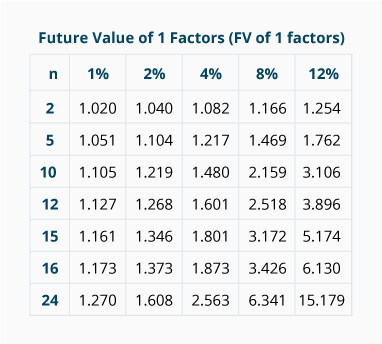
Use the following future value of 1 factors for solving the remaining questions:
Future Value of 1 Factors (FV of 1 factors)

n 1% 2% 4% 8% 12%
2 1.020 1.040 1.082 1.166 1.254
5 1.051 1.104 1.217 1.469 1.762
10 1.105 1.219 1.480 2.159 3.106
12 1.127 1.268 1.601 2.518 3.896
15 1.161 1.346 1.801 3.172 5.474
16 1.173 1.373 1.873 3.426 6.130
24 1.270 1.608 2.563 6.341 15.179

14. A deposit of $1,000 on January 1, 2011 will have a future value of $________ on December 31, 2015 (or January 1, 2016) if it is invested at 8% per year and the interest is compounded annually.


15. A deposit of $10,000 on January 1, 2011 will have a future value of $________ on December 31, 2015 (or January 1, 2016) if it is invested at 8% per year and the interest is compounded semiannually.


16. A deposit of $2,000 on January 1, 2011 will have a future value of $________ on December 31, 2012 (or January 1, 2013) if it is invested at 12% per year and the interest is compounded monthly.


17. A deposit of $1,000 on January 1, 2011 will have a future value of $________ on December 31, 2014 (or January 1, 2015) if it is invested at 8% per year and the interest is compounded quarterly.


18. The interest rate that is necessary for a deposit of $1,000 to grow to $5,474 after 15 years of interest compounded annually is _____% per year.


19. The annual interest rate that is necessary for a deposit of $1,000 to grow to $1,373 after four years of interest compounded quarterly is _____% per year.


20. The number of years required for an investment of $1,000 to grow to $2,563 when invested at an annual rate of 8% compounded semiannually is ______ years.


Get access to all of our accounting exams (1,660 questions) when you join AccountingCoach Pro.


Accounting Exams

1,660 total exam questions


Bookkeeping Proficiency Exam

Financial Accounting Exams

Managerial & Cost Accounting Exams

Financial Ratios Exam


These exams are only available in our new AccountingCoach Pro members area.