Introduction
A chart of accounts is a listing of the names of the accounts that a company has identified and made available for recording transactions in its general ledger. A company has the flexibility to tailor its chart of accounts to best suit its needs, including adding accounts as needed.
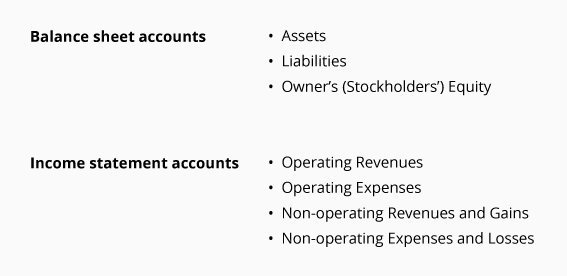
Within the chart of accounts you will find that the accounts are typically listed in the following order:

Within the categories of operating revenues and operating expenses, accounts might be further organized by business function (such as producing, selling, administrative, financing) and/or by company divisions, product lines, etc.
A company’s organization chart can serve as the outline for its accounting chart of accounts. For example, if a company divides its business into ten departments (production, marketing, human resources, etc.), each department will likely be accountable for its own expenses (salaries, supplies, phone, etc.). Each department will have its own phone expense account, its own salaries expense, etc.
A chart of accounts will likely be as large and as complex as the company itself. An international corporation with several divisions may need thousands of accounts, whereas a small local retailer may need as few as one hundred accounts.
WATCH NOW
Advance Your Career with Our PRO Training
Sample Chart of Accounts For a Large Corporation
Each account in the chart of accounts is typically assigned a name and a unique number by which it can be identified. (Software for some small businesses may not require account numbers.) Account numbers are often five or more digits in length with each digit representing a division of the company, the department, the type of account, etc.
As you will see, the first digit might signify if the account is an asset, liability, etc. For example, if the first digit is a “1” it is an asset. If the first digit is a “5” it is an operating expense.
A gap between account numbers allows for adding accounts in the future. The following is a partial listing of a sample chart of accounts.
Current Assets (account numbers 10000 – 16999)
10100 Cash – Regular Checking
10200 Cash – Payroll Checking
10600 Petty Cash Fund
12100 Accounts Receivable
12500 Allowance for Doubtful Accounts
13100 Inventory
14100 Supplies
15300 Prepaid Insurance
Property, Plant, and Equipment (account numbers 17000 – 18999)
17000 Land
17100 Buildings
17300 Equipment
17800 Vehicles
18100 Accumulated Depreciation – Buildings
18300 Accumulated Depreciation – Equipment
18800 Accumulated Depreciation – Vehicles
Current Liabilities (account numbers 20000 – 24999)
20100 Notes Payable – Credit Line #1
20200 Notes Payable – Credit Line #2
21000 Accounts Payable
22100 Wages Payable
23100 Interest Payable
24500 Unearned Revenues
Long-term Liabilities (account numbers 25000 – 26999)
25100 Mortgage Loan Payable
25600 Bonds Payable
25650 Discount on Bonds Payable
Stockholders’ Equity (account numbers 27000 – 29999)
27100 Common Stock, No Par
27500 Retained Earnings
29500 Treasury Stock
Operating Revenues (account numbers 30000 – 39999)
31010 Sales – Division #1, Product Line 010
31022 Sales – Division #1, Product Line 022
32015 Sales – Division #2, Product Line 015
33110 Sales – Division #3, Product Line 110
Cost of Goods Sold (account numbers 40000 – 49999)
41010 COGS – Division #1, Product Line 010
41022 COGS – Division #1, Product Line 022
42015 COGS – Division #2, Product Line 015
43110 COGS – Division #3, Product Line 110
Marketing Expenses (account numbers 50000 – 50999)
50100 Marketing Dept. Salaries
50150 Marketing Dept. Payroll Taxes
50200 Marketing Dept. Supplies
50600 Marketing Dept. Telephone
Payroll Dept. Expenses (account numbers 59000 – 59999)
59100 Payroll Dept. Salaries
59150 Payroll Dept. Payroll Taxes
59200 Payroll Dept. Supplies
59600 Payroll Dept. Telephone
Other (account numbers 90000 – 99999)
91800 Gain on Sale of Assets
96100 Loss on Sale of Assets
Sample Chart of Accounts for a Small Company
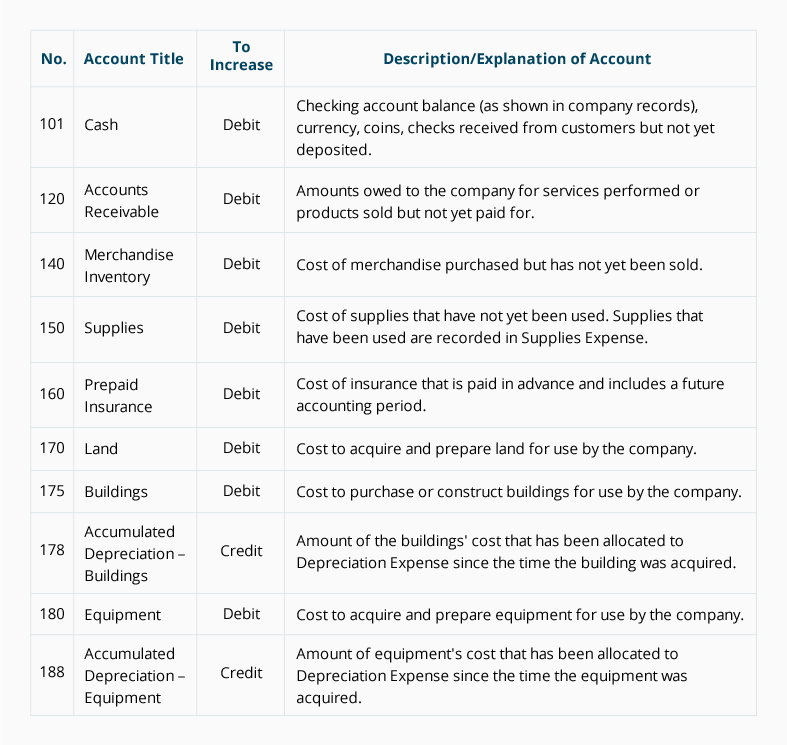
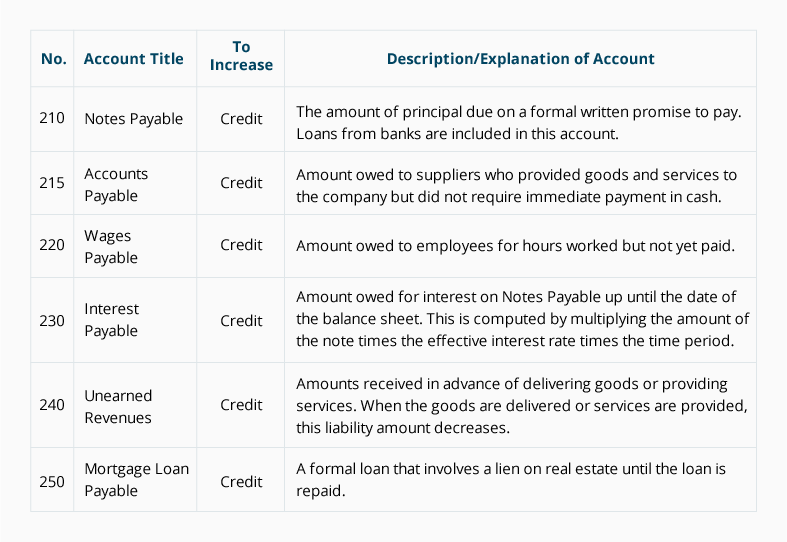
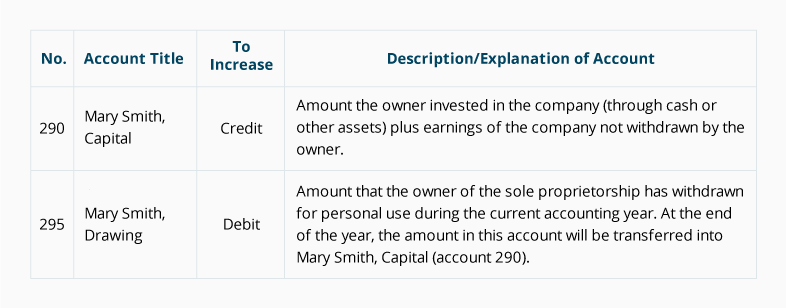
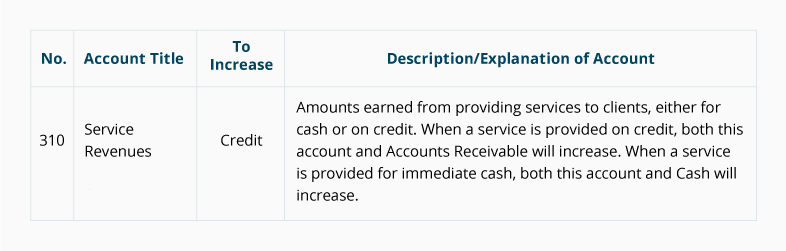
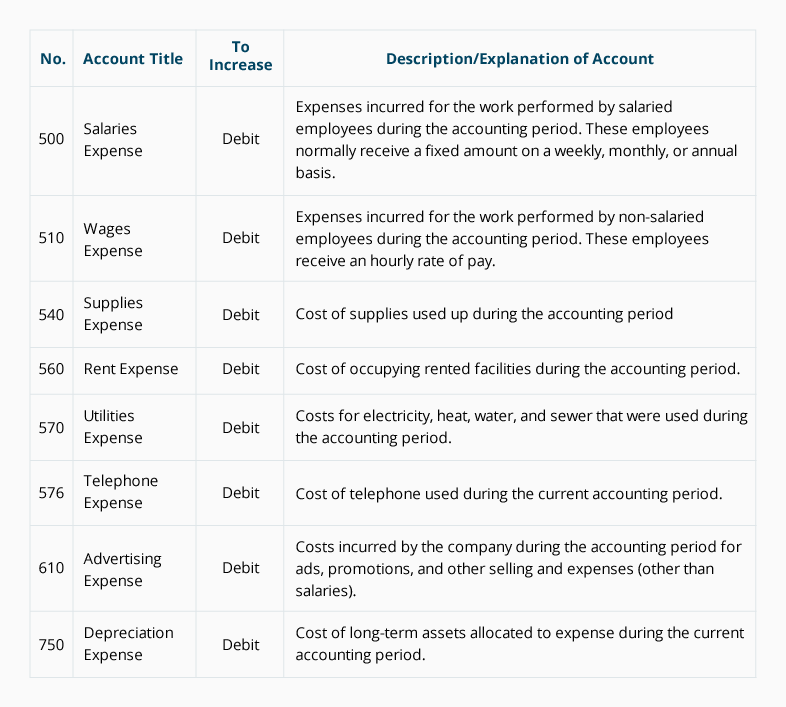
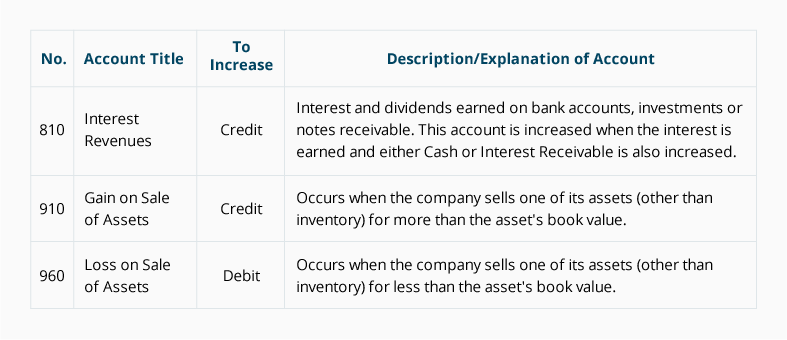
This is a partial listing of another sample chart of accounts. Note that each account is assigned a three-digit number followed by the account name. The first digit of the number signifies if it is an asset, liability, etc. For example, if the first digit is a “1” it is an asset, if the first digit is a “3” it is a revenue account, etc. The company decided to include a column to indicate whether a debit or credit will increase the amount in the account. This sample chart of accounts also includes a column containing a description of each account in order to assist in the selection of the most appropriate account.
Asset Accounts

Liability Accounts

Owner’s Equity Accounts

Operating Revenue Accounts

Operating Expense Accounts

Non-Operating Revenues and Expenses, Gains, and Losses

Accounting software frequently includes sample charts of accounts for various types of businesses. It is expected that a company will expand and/or modify these sample charts of accounts so that the specific needs of the company are met. Once a business is up and running and transactions are routinely being recorded, the company may add more accounts or delete accounts that are never used.
At Least Two Accounts for Every Transaction
The chart of accounts lists the accounts that are available for recording transactions. In keeping with the double-entry system of accounting, a minimum of two accounts is needed for every transaction—at least one account is debited and at least one account is credited.
When a transaction is entered into a company’s accounting software, it is common for the software to prompt for only one account name—this is because the software is programmed to automatically assign one of the accounts. For example, when using accounting software to write a check, the software automatically reduces the asset account Cash and prompts you to designate the other account(s) such as Rent Expense, Advertising Expense, etc.
Some general rules about debiting and crediting the accounts are:
- Expense accounts are debited and have debit balances
- Revenue accounts are credited and have credit balances
- Asset accounts normally have debit balances
- To increase an asset account, debit the account
- To decrease an asset account, credit the account
- Liability accounts normally have credit balances
- To increase a liability account, credit the account
- To decrease a liability account, debit the account
Note: To learn more about debits and credits, visit our Explanation and Quiz for this topic. To learn more about the role of bookkeepers and accountants, visit our Accounting Careers page.
Where to Go From Here
We recommend taking our Practice Quiz next, and then continuing with the rest of our Chart of Accounts materials (see the full outline below).
We also recommend joining PRO to unlock our premium materials (certificates of achievement, video training, flashcards, visual tutorials, quick tests, quick tests with coaching, cheat sheets, guides, puzzles, business forms, printable PDF files, progress tracking, badges, points, medal rankings, activity streaks, public profile pages, and more).
Disclaimer
You should consider our materials to be an introduction to selected accounting and bookkeeping topics (with complexities likely omitted). We focus on financial statement reporting and do not discuss how that differs from income tax reporting. Therefore, you should always consult with accounting and tax professionals for assistance with your specific circumstances.