Accounting


Quiz for the Topic...

Inventory and
Cost of Goods Sold


Print (PDF)


NOTE: For multiple-choice and true/false questions, simply place your cursor over what you think is the correct answer. (There is no need to click the answer.) For fill-in-the-blank questions place your cursor over the _________.


If you have difficulty answering the following questions, learn more about this topic by reading our Inventory and Cost of Goods Sold Explanation.

We also have Crosswords and Q&A for this topic.


 1. The inventory cost flow assumption where the cost of the most recent purchase is matched first against sales revenues is
FIFO              LIFO              Average


 2. The inventory cost flow assumption where the cost of the most recent purchases are likely to remain in inventory
FIFO              LIFO              Average


 3. The inventory cost flow assumption where the oldest cost of inventory items is likely to remain on the balance sheet is
FIFO              LIFO              Average


 4. The account Inventory will appear on the balance sheet as a current asset at an amount that often reflects the __________ of the merchandise on hand.
cost              sales value


 5. The inventory system that does NOT update the Inventory account automatically at the time of each purchase or sales is the _______________ method/system.
periodic              perpetual


 6. If a company is experiencing continuous cost increases for the merchandise that it purchases, which cost flow assumption will result in the least amount of profit and the least amount of income tax expense?
FIFO              LIFO              Average


 7. A company in the computer industry is experiencing continuously lower costs. Which cost flow assumption will result in less income tax expense for this company?
FIFO              LIFO              Average


 8. A company purchased items for inventory during 2011 at continuously higher costs. Its last two purchases of 2011 were 20 units on December 20 at a cost of $14 per unit and 30 units on December 30 at a cost of $15 per unit. On December 28, 2011 the company made its last sale for the year when it sold 10 units. Which inventory cost flow assumption will cause the $15 cost per unit to be expensed as part of the year 2011's cost of goods sold?
LIFO periodic              LIFO perpetual              Neither


Use the following information for questions 9 through 14:
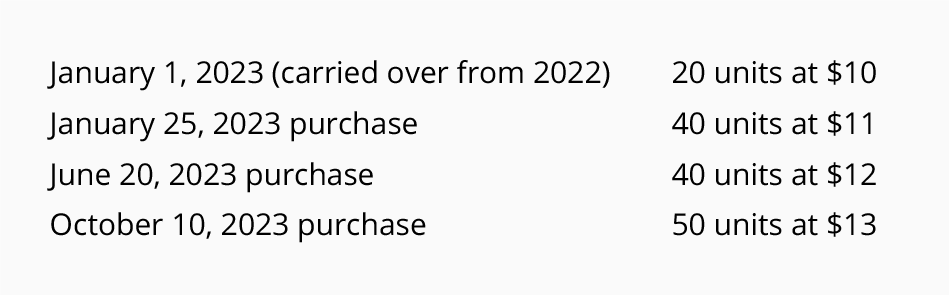
A company purchased merchandise to be resold at increasing costs during the year 2011. The purchases were made at the following costs...

January 1, 2011 (carried over from 2010) 20 units at $10
January 25, 2011 purchase 40 units at $11
June 20, 2011 purchase 40 units at $12
October 10, 2011 purchase 50 units at $13

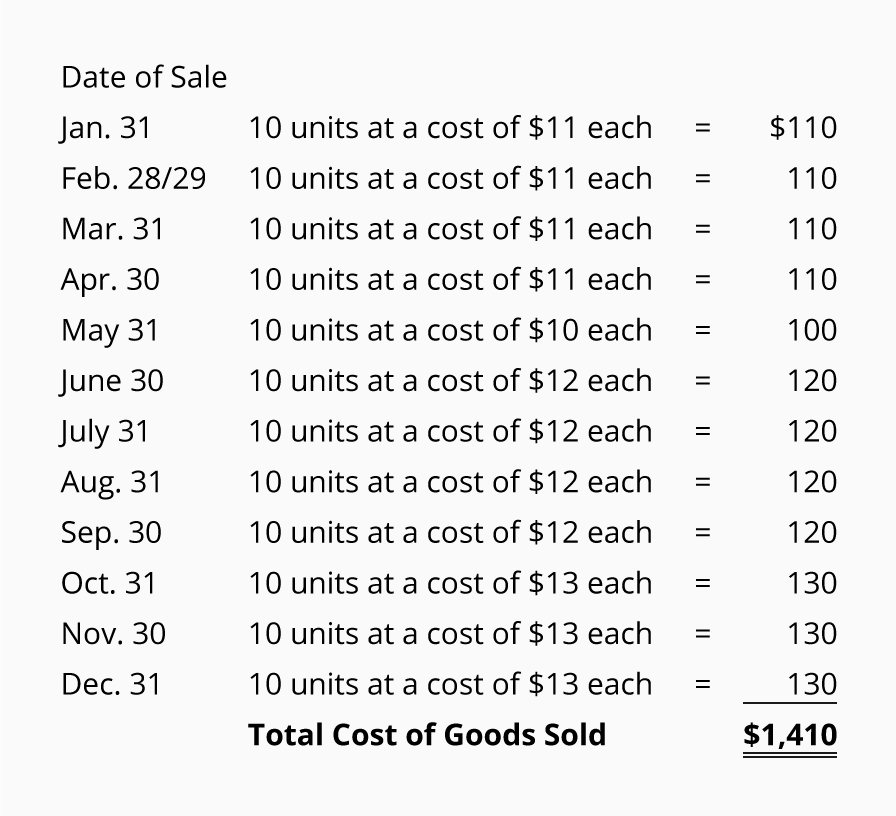
The company sold 10 items at the end of each month.

 9. What are the number of units and the cost of the goods available for sale?
_____ units     $________ cost of goods available for sale


10. Assuming the LIFO periodic cost flow assumption, what will be the company's cost of goods sold for the 120 items sold in 2011?
$1,380              $1,386              $1,400              $1,460


11. Assuming the FIFO periodic cost flow assumption, what will be the company's cost of goods sold for the 120 items sold in 2011?
$1,380              $1,386              $1,410              $1,460


12. Assuming the periodic weighted-average cost flow assumption, what is the company's cost of goods sold for the 120 items sold in 2011?
$1,386              $1,410              $1,416              $1,460


13. Assuming the LIFO perpetual cost flow assumption, what will be the company's cost of goods sold for the 120 items sold in 2011?
$1,386              $1,410              $1,416              $1,460


14. Assuming the perpetual moving-average cost flow assumption, what is the company's cost of goods sold for the 120 items sold in 2011?
$1,386              $1,410              $1,416              $1,460


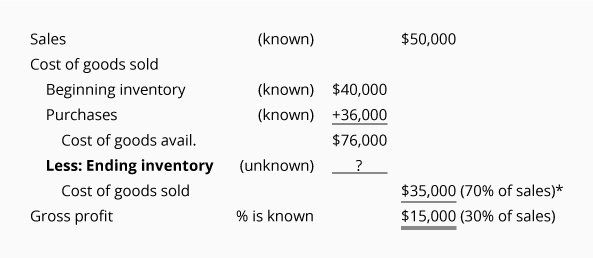
15. A company's inventory was destroyed in a fire on January 28, 2012. The company's December 31, 2011 inventory had a cost of $40,000. The company's gross profit has consistently been 30% of sales. During January the company purchased merchandise costing $36,000 and sales of $50,000 at regular selling prices. What is the estimated cost of the inventory that was destroyed on January 28, 2012?
$26,000              $35,000              $41,000


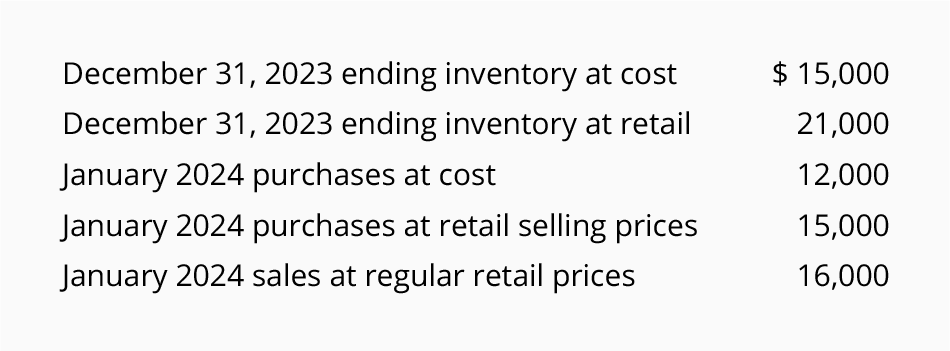
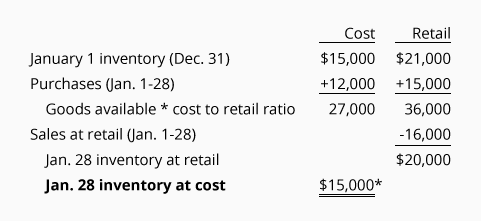
16. A retailer has the following information:
December 31, 2011 ending inventory at cost$ 15,000
December 31, 2011 ending inventory at retail 21,000
January 2012 purchases at cost 12,000
January 2012 purchases at retail selling prices 15,000
January 2012 sales at regular retail prices 16,000

The estimated cost of inventory to be shown on the retailer's January 31, 2012 balance sheet is
$15,000              $16,000              $20,000


17. A company has properly recorded all of its purchases of merchandise inventory, but made an error when counting its ending inventory. As a result of the error the company's Inventory account is overstated by $24,000. (This means that the amount in the Inventory account is too high by $24,000.) What is the impact of this error on the company's income statement? Specifically, the company's reported profit (ignoring income tax expense) in the period of the error is....
Too High              Too Low              Not Affected


18. A retailer's inventory cost should include freight-in on the merchandise purchased with terms FOB shipping point? True False


19. Net Purchases is Gross Purchases minus Purchase Returns and Allowances and __________  ___________.


20. The difference between the Cost of Goods Available and the Cost of Goods Sold is __________  ___________.


Get access to all of our accounting exams (1,660 questions) when you join AccountingCoach Pro.


Accounting Exams

1,660 total exam questions


Bookkeeping Proficiency Exam

Financial Accounting Exams

Managerial & Cost Accounting Exams

Financial Ratios Exam


These exams are only available in our new AccountingCoach Pro members area.