Introduction
Activity based costing (ABC) assigns manufacturing overhead costs to products in a more logical manner than the traditional approach of simply allocating costs on the basis of machine hours. Activity based costing first assigns costs to the activities that are the real cause of the overhead. It then assigns the cost of those activities only to the products that are actually demanding the activities.
Let’s discuss activity based costing by looking at two products manufactured by the same company. Product 124 is a low volume item which requires certain activities such as special engineering, additional testing, and many machine setups because it is ordered in small quantities. A similar product, Product 366, is a high volume product—running continuously—and requires little attention and no special activities. If this company used traditional costing, it might allocate or “spread” all of its overhead to products based on the number of machine hours. This will result in little overhead cost allocated to Product 124, because it did not have many machine hours. However, it did demand lots of engineering, testing, and setup activities. In contrast, Product 366 will be allocated an enormous amount of overhead (due to all those machine hours), but it demanded little overhead activity. The result will be a miscalculation of each product’s true cost of manufacturing overhead. Activity based costing will overcome this shortcoming by assigning overhead on more than the one activity, running the machine.
Activity based costing recognizes that the special engineering, special testing, machine setups, and others are activities that cause costs—they cause the company to consume resources. Under ABC, the company will calculate the cost of the resources used in each of these activities. Next, the cost of each of these activities will be assigned only to the products that demanded the activities. In our example, Product 124 will be assigned some of the company’s costs of special engineering, special testing, and machine setup. Other products that use any of these activities will also be assigned some of their costs. Product 366 will not be assigned any cost of special engineering or special testing, and it will be assigned only a small amount of machine setup.
Activity based costing has grown in importance in recent decades because (1) manufacturing overhead costs have increased significantly, (2) the manufacturing overhead costs no longer correlate with the productive machine hours or direct labor hours, (3) the diversity of products and the diversity in customers’ demands have grown, and (4) some products are produced in large batches, while others are produced in small batches.
Note: Our Guide to Managerial & Cost Accounting is designed to deepen your understanding of topics such as product costing, overhead cost allocations, estimating cost behavior, costs for decision making, and more. It is only available when you join AccountingCoach PRO.
WATCH NOW
Advance Your Career with Our PRO Training
Activity Based Costing with Two Activities
Let’s illustrate the concept of activity based costing by looking at two common manufacturing activities: (1) the setting up of a production machine for running batches of products, and (2) the actual production of the units of product.
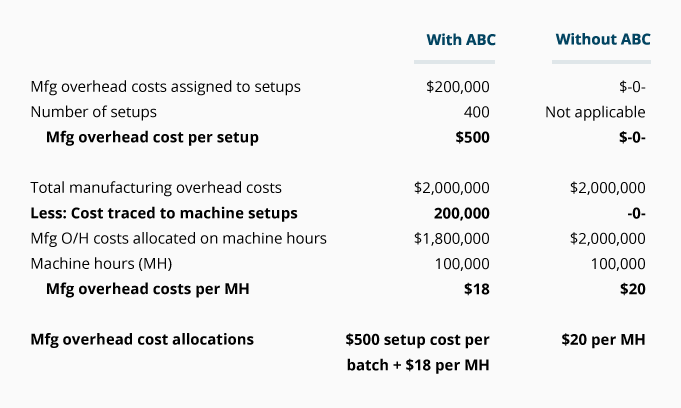
We will assume that a company has annual manufacturing overhead costs of $2,000,000—of which $200,000 is directly involved in setting up the production machines. During the year the company expects to perform 400 machine setups. Let’s also assume that the batch sizes vary considerably, but the setup efforts for each machine are similar.
The cost per setup is calculated to be $500 ($200,000 of cost per year divided by 400 setups per year). Under activity based costing, $200,000 of the overhead will be viewed as a batch-level cost. This means that $200,000 will first be allocated to batches of products to be manufactured (referred to as a Stage 1 allocation), and then be assigned to the units of product in each batch (referred to as Stage 2 allocation). For example, if Batch X consists of 5,000 units of product, the setup cost per unit is $0.10 ($500 divided by 5,000 units). If Batch Y is 50,000 units, the cost per unit for setup will be $0.01 ($500 divided by 50,000 units). For simplicity, let’s assume that the remaining $1,800,000 of manufacturing overhead is caused by the production activities that correlate with the company’s 100,000 machine hours.
For our simple two-activity example, let’s see how the rates for allocating the manufacturing overhead would look with activity based costing and without activity based costing:

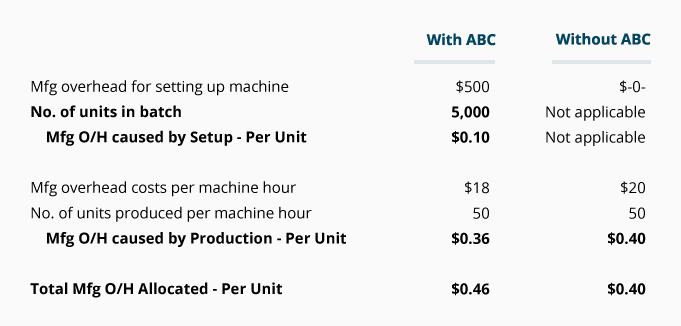
Next, let’s see what impact these different allocation techniques and overhead rates would have on the per unit cost of a specific unit of output. Assume that a company manufactures a batch of 5,000 units and it produces 50 units per machine hour, here is how the cost assigned to the units with activity based costing and without activity based costing compares:

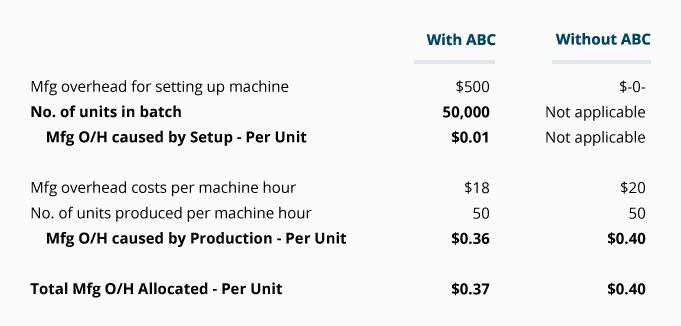
If a company manufactures a batch of 50,000 units and produces 50 units per machine hour, here is how the cost assigned to the units with ABC and without ABC compares:
As the tables above illustrate, with activity based costing the cost per unit decreases from $0.46 to $0.37 because the cost of the setup activity is spread over 50,000 units instead of 5,000 units. Without ABC, the cost per unit is $0.40 regardless of the number of units in each batch. If companies base their selling prices on costs, a company not using an ABC approach might lose the large batch work to a competitor who bids a lower price based on the lower, more accurate overhead cost of $0.37. It’s also possible that a company not using ABC may find itself being the low bidder for manufacturing small batches of product, since its $0.40 is lower than the ABC model of $0.46 for a batch size of 5,000 units. With its bid price based on manufacturing overhead of $0.40—but a true cost of $0.46—the company may end up doing lots of production for little or no profit.
Our example with just two activities (production and setup) illustrates how the cost per unit using the activity based costing method is more accurate in reflecting the actual efforts associated with production. As companies began measuring the costs of activities (instead of focusing on the accountant’s departmental classifications), they began using ABC cost information to practice activity based management. For example, with the cost of setting up a machine now being measured and discussed, managers began to ask questions such as:
- Why is the cost of setting up a production machine so expensive?
- What can be done to reduce the setup cost?
- If the setup costs cannot be reduced, are the selling prices adequate to cover all of the company’s costs—including the setup cost that was previously buried in the overall machine-hour overhead rate?
Activity Based Costing with Four Activities
Let’s add two more activities to our example: procurement and material handling. The costs of these two activities are not caused by—nor do they correlate with—machine hours. Rather, we will assume that both of these activities are related to the physical weight of the direct material used in making the product.
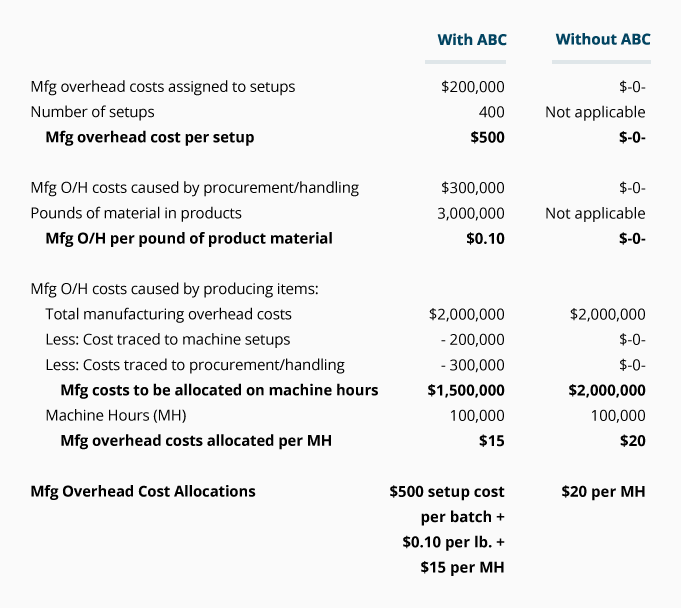
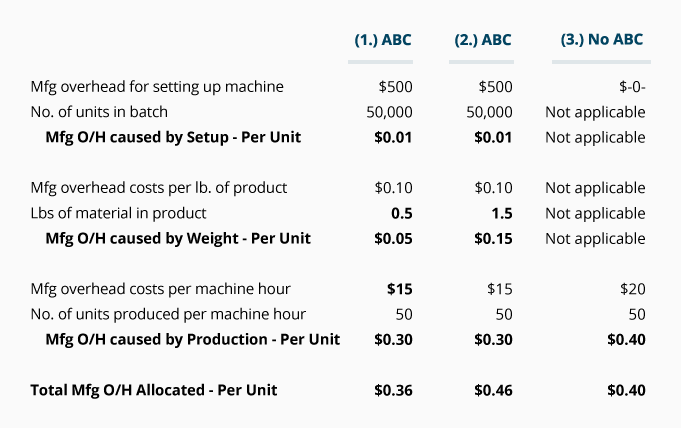
The company determines that $300,000 of its annual manufacturing overhead is associated with procurement and material handling. As a result, the company removes $300,000 from the manufacturing overhead that will be allocated via machine hours, and instead plans to allocate the $300,000 to the products based on the weight of the materials used. The company expects that during the year it will procure and handle 3,000,000 pounds of material. Under activity based costing, the company will assign $0.10 ($300,000 divided by 3,000,000 pounds) per pound of product weight to each unit manufactured. The end result is that the heavier parts will not only have more direct material cost, they will also be assigned more factory overhead than the lighter parts. By assigning some manufacturing overhead to a product based on the product’s weight, the remaining manufacturing overhead assigned via machine hours will be reduced. These points are illustrated in the following table:

In the table below we can see how ABC would assign costs to the following:
- A product that weighs 0.5 pound and is produced in a batch of 50,000 units at a rate of 50 per hour.
- A product that weighs 1.5 pounds and is produced in a batch of 50,000 units at a rate of 50 per hour.
- No activity based costing allocations—all manufacturing overhead costs are allocated entirely via machine hours.

If the manufacturing overhead costs are caused by a number of activities such as setup, procurement, handling, and production, then using the activity based costing method of determining costs will give you a result that is closer to the true costs. As you can see, the product that weighs 0.5 pound is assigned $0.36 of manufacturing overhead, while the product weighing 1.5 pounds is assigned $0.46 of manufacturing overhead. Under the traditional costing allocations the procurement and handling costs would be assigned on production hours. Keep in mind that whenever manufacturers have a diverse lineup of products, allocating costs on a single basis (such as machine hours) will result in inaccurate per-unit manufacturing overhead costs.
Where to Go From Here
We recommend taking our Practice Quiz next, and then continuing with the rest of our Activity Based Costing materials (see the full outline below).
We also recommend joining PRO to unlock our premium materials (certificates of achievement, video training, flashcards, visual tutorials, quick tests, quick tests with coaching, cheat sheets, guides, puzzles, business forms, printable PDF files, progress tracking, badges, points, medal rankings, activity streaks, public profile pages, and more).
Disclaimer
You should consider our materials to be an introduction to selected accounting and bookkeeping topics (with complexities likely omitted). We focus on financial statement reporting and do not discuss how that differs from income tax reporting. Therefore, you should always consult with accounting and tax professionals for assistance with your specific circumstances.