NOTE: For multiple-choice and true/false questions, simply place your cursor over what you think is the correct answer. (There is no need to click the answer.) For fill-in-the-blank questions place your cursor over the _________.
If you have difficulty answering the following questions, learn more about this topic by reading our Break-even Point Explanation.
We also have Crosswords and Q&A for this topic.
| 1. |
Fixed Expenses do not change in total when there is a modest change in sales. |
True |
False |
| 2. |
An example of a fixed expense would be a 5% sales commission. |
True |
False |
| 3. |
Property taxes and rent are often fixed expenses. |
True |
False |
| 4. |
Variable expenses change in total as volume changes. |
True |
False |
| 5. |
An example of a variable expense is an office manager's monthly salary. |
True |
False |
| 6. |
A retailer's cost of goods sold is an example of a variable expense. |
True |
False |
| 7. |
Contribution margin is defined as sales (or revenues) minus variable expenses. |
True |
False |
| 8. |
Break-even point is the point where revenues equal the total of all expenses including the cost of goods sold. |
True |
False |
| 9. |
The break-even point in dollars of revenues is equal to the total of the fixed expenses divided by the contribution margin per unit. |
True |
False |
| 10. |
If a company requires a profit of $30,000 (instead of breaking even), the $30,000 should be combined with the fixed expenses in order to compute the point at which the company will earn $30,000. |
True |
False |
| 11. |
If a company has mixed expenses, the fixed component can be combined with the company's fixed expenses and the variable component can be combined with the company's variable expenses. |
True |
False |
| 12. |
Decreasing a company's fixed expenses should reduce the break-even point. |
True |
False |
| 13. |
The contribution margin per unit is the selling price per unit minus the fixed expenses per unit. |
True |
False |
| 14. |
Break-even analysis is useful for companies that sell products, but it is not useful for companies that provide services. |
True |
False |
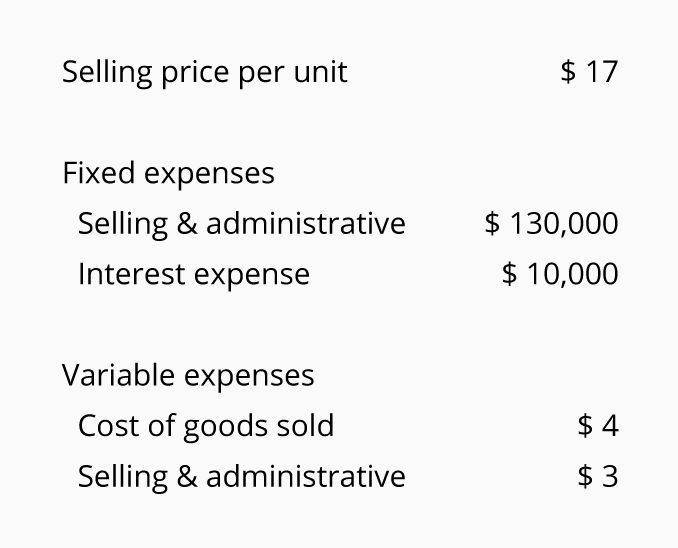
Use this information to answer questions 15 through 17:
| Selling Price per unit | $ 17 |
|
| Fixed Expenses | |
|
Selling & Administrative |
$ 130,000 |
|
Interest Expense | $ 10,000 |
|
| Variable Expenses | |
| Cost of Goods Sold | $ 4 |
| Selling & Administrative | $ 3 |
|
| 15. |
What is the company's contribution margin? |
|
$10
$13
$14
|
| 17. |
If the company wants to earn a profit of $42,000 instead of breaking even, what is the number of units the company must sell? |
|
14,000
18,200
26,000
|
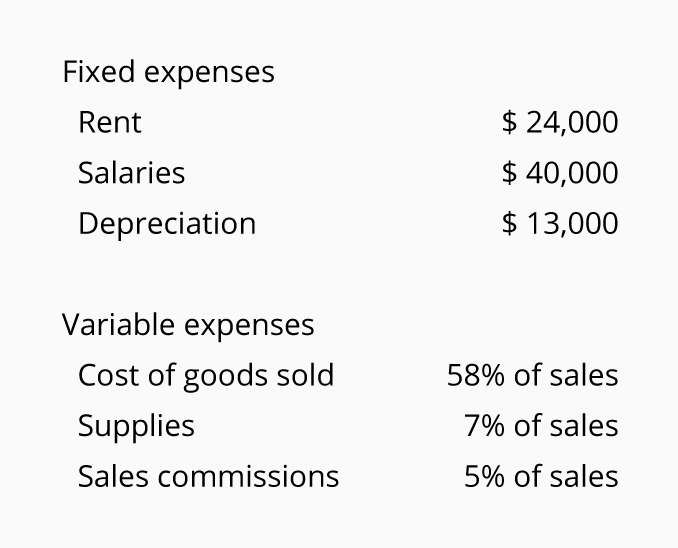
Use this information to answer questions 18 through 20:
| Fixed Expenses | |
| Rent | $ 24,000 |
| Salaries | $ 40,000 |
| Depreciation | $ 13,000 |
|
| Variable Expenses | |
| Cost of Goods Sold | 58% of sales |
| Supplies | 7% of sales |
| Sales Commissions | 5% of sales |
|
| 20. |
If the company wants to earn a profit of $35,000 instead of breaking even, what
is the amount of sales or revenue dollars the company must achieve? |
|
$112,000
$145,000
$373,333
|