NOTE: For multiple-choice and true/false questions, simply place your cursor over what you think is the correct answer. (There is no need to click the answer.) For fill-in-the-blank questions place your cursor over the _________.
If you have difficulty answering the following questions, learn more about this topic by reading our Present Value of an Ordinary Annuity Explanation.
| 1. |
After the payments in an ordinary annuity have been discounted to time period 0, you will have the ____________ value of the ordinary annuity.
|
| 3. |
The interest removed from the payments in an ordinary annuity when calculating the present value is also referred to as ______________.
|
| 4. |
In the calculation of present values, the payment amounts that are discounted are not accrual accounting amounts; rather they are __________ amounts.
|
| 5. |
If the cash amount of a transaction is not known, accountants will record the transaction at the fair __________ value of the property or services exchanged. If neither amount is available, the accountant will record the transaction at the ___________ value of the future cash amounts.
|
| 7. |
Under the accrual basis of accounting, the discount on notes payable should be reported as interest _____________ over the life of the note.
|
| 8. |
If you know the present value, the recurring payment amount, and length of the annuity, you can calculate the __________ ________ by using a present value of an ordinary annuity factor.
|
| 10. |
You can determine the number of payments (n) in an ordinary annuity, if you know the amount of each payment, the present value of the annuity, and the ___________ _________.
|
| 11. |
Company X received a promissory note from Corp Y. The note does not specify any interest and it requires $3,000 to be paid at the end of each year for four years. Which interest rate should Company X use to discount this note receivable to its present value? |
|
Borrowing rate of Company X
Borrowing rate of Corp Y
|
| 12. |
A present value of an ordinary annuity table is used to compute the present value of a five-year ordinary annuity with a payment occurring every three months. If the company has a time value of money of 12% per year, compounded quarterly, the number of periods (n) to be used in the calculation is _________ and the interest rate is _________.
|
| 13. |
A present value of an ordinary annuity (PVOA) table is used to compute the amount of a single deposit to be made today into an account earning interest of 6% per year compounded monthly. The deposit must be sufficient to cover a withdrawal of an identical amount each month for 10 years. At the end of the 10 years, the balance in the account should be $0. When using the PVOA Table to solve for the amount needed (the present value), the number of periods (n) is _________ and the interest rate per period is __________.
|
Use the following information for answering Questions 14 - 18.
Company X's accounting year ends on December 31 of each year. On December 31, 2007 Company X received a promissory note from Corp. Y in exchange for services provided by Company X. The fair market value of the services is not known and the fair market value of the note is not known. The note calls for two payments of $10,000 each: one on December 31, 2008 and one on December 31, 2009. No interest is specified in the note. Company X computed the present value of the note to be $17,000 as of December 31, 2007.
| 14. |
The amount of service revenue that Company X should report in 2007 is $_____________.
|
| 15. |
The amount of interest revenue that Company X should report in 2007 is $_____________.
|
| 16. |
The carrying value of the note at December 31, 2007 is $_____________.
|
| 17. |
The amount of interest revenue that Company X should report in 2008, if it amortizes the discount on notes receivable by using the straight-line method is $_____________.
|
| 18. |
If the $3,000 of discount is a significant amount in light of Company X's net income and other financial information, the ______________ _____________ _________ method of amortization should be used.
|
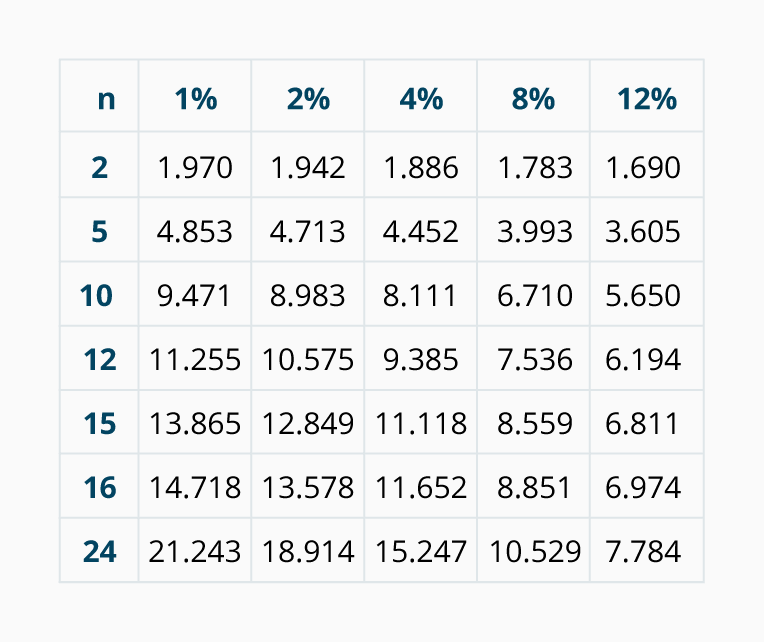
Use the following present value of an ordinary annuity factors for solving the remaining questions:
| n |
1% |
2% |
4% |
8% |
12% |
| 2 |
1.970 |
1.942 |
1.886 |
1.783 |
1.690 |
| 5 |
4.853 |
4.713 |
4.452 |
3.993 |
3.605 |
| 10 |
9.471 |
8.983 |
8.111 |
6.710 |
5.650 |
| 12 |
11.255 |
10.575 |
9.385 |
7.536 |
6.194 |
| 15 |
13.865 |
12.849 |
11.118 |
8.559 |
6.811 |
| 16 |
14.718 |
13.578 |
11.652 |
8.851 |
6.974 |
| 24 |
21.243 |
18.914 |
15.247 |
10.529 |
7.784 |
| 19. |
Assuming the time value of money is 8% compounded annually, the present value on January 1, 2008 of a $1,000 cash amount occurring on January 1 of each the years 2009, 2010, 2011, 2012, and 2013 is $_____________.
|
| 20. |
Assuming the time value of money is 8% per year compounded quarterly, the present value on December 31, 2007 of a $1,000 cash amount occurring on March 31, June 30, September 30, and December 31 of each of the years 2008, 2009, 2010, and 2011 is $_____________.
|
| 21. |
Assuming the time value of money is 12% per year compounded monthly, the present value on January 1, 2008 of a $1,000 cash amount occurring on the last day of each month of 2008 is $_____________.
|
| 22. |
As of January 1, 2008, a non-interest bearing note has a present value of $5,650. The note requires ten payments of $1,000 each to be made on December 31 of each year beginning on December 31, 2008. The interest rate used to calculate the present value was _______% compounded _______________.
|
| 23. |
A fund earning 8% per year compounded annually has a balance of $8,559 as of January 1, 2008. The owner of the fund wishes to withdraw $1,000 on December 31 of each year starting on December 31, 2008. The number of withdrawals that can be made before the fund reaches a $0 balance is ___________. The last withdrawal will occur on December 31, ______.
|
| 24. |
The answers to PVOA calculations can often be verified by preparing an _____________________ schedule, which shows the amount of interest and principal contained in each payment.
|