Accounting


Quiz for the Topic...

Present Value of a
Single Amount


Print (PDF)


NOTE: For multiple-choice and true/false questions, simply place your cursor over what you think is the correct answer. (There is no need to click the answer.) For fill-in-the-blank questions place your cursor over the _________.


If you have difficulty answering the following questions, learn more about this topic by reading our Present Value of a Single Amount Explanation.

We also have Crosswords and Q&A for this topic.


 1. A future amount that has been discounted to time period 0 becomes a _________________ value.


 2. Interest earned on interest is referred to as the ___________________ of interest.


 3. The name associated with the amount removed from a future value when discounting it to the present value is _________________.


 4. In the calculation of present values, the future amounts that are discounted are not accrual accounting amounts; rather they are future __________ amounts.


 5. If the cash amount of a transaction is not known, accountants will record the transaction at the fair __________ value of the property or services exchanged. If neither amount is available, the accountant will record the transaction at the ___________ value of the future cash amounts.


 6. Under the accrual basis of accounting, the discount on notes receivable should be reported as interest revenue
when the note is received          over the life of the note          when the note matures


 7. Under the accrual basis of accounting, the discount on notes payable should be reported as interest expense
when the note is received          over the life of the note          when the note matures


 8. If you know the present value, future value, and length of time before the future amount will occur, you can compute the __________  ________ by using a present value calculation.


 9. Which present value factor is larger: the PV of 1 factor for 10% or the PV of 1 factor for 12%?
PV of 1 factor for 10%              PV of 1 factor for 12%


10. You can determine the number of periods (n) in a present value calculation, if you know the future amount, the present value, and the ___________  _________.


11. Company X received a promissory note from Corp Y. The note does not specify any interest and it will be due in three years. Which interest rate should Company X use to discount this note receivable to its present value?
Borrowing rate of Company X              Borrowing rate of Corp Y


12. A present value of 1 table is used to compute the present value of a single amount occurring in five years. If the company has a time value of money of 12% per year compounded quarterly, the number of periods (n) to be used in the calculation is _________ and the interest rate is _________.


13. A present value of 1 table is used to compute the amount of a single deposit to be made today into an account earning interest of 6% per year compounded monthly. The deposit will remain in the account for 10 years. At the end of the 10 years, the account balance needs to be $100,000. To solve for the present value, the number of periods (n) is _________ and the interest rate per period is __________.


Use the following information for answering Questions 14 - 18.
Company X's accounting year ends on December 31 of each year. On December 31, 2011 Company X received a promissory note from Corp. Y in exchange for services provided by Company X. The fair market value of the services is not known and the fair market value of the note is not known. The note is for $20,000 and it is due on December 31, 2013. No interest is specified in the note. Company X computed the present value of the note to be $16,000 as of December 31, 2011.

14. The amount of service revenue that Company X should report in 2011 is $_____________.


15. The amount of interest revenue that Company X should report in 2011 is $_____________.


16. The carrying value of the note at December 31, 2011 is $_____________.


17. The amount of interest revenue that Company X should report in 2012, if it amortizes the discount on notes receivable by using the straight-line method is $_____________.


18. If the $4,000 of discount is a significant amount in light of Company X's net income and other financial information, the ______________  _____________  _________ method of amortization should be used.


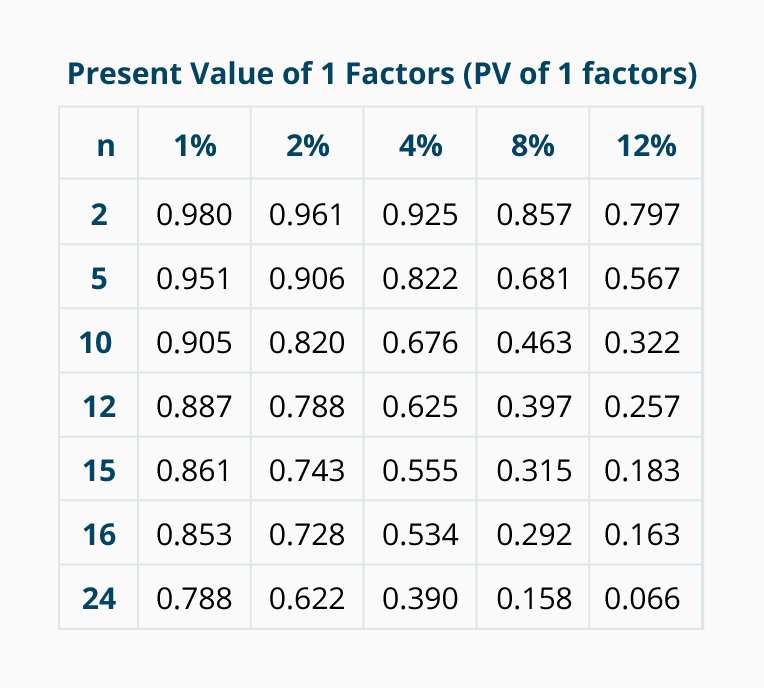
Use the following present value of 1 factors for solving the remaining questions:
Present Value of 1 Factors (PV of 1 factors)

n 1% 2% 4% 8% 12%
2 0.980 0.961 0.925 0.857 0.797
5 0.951 0.906 0.822 0.681 0.567
10 0.905 0.820 0.676 0.463 0.322
12 0.887 0.788 0.625 0.397 0.257
15 0.861 0.743 0.555 0.315 0.183
16 0.853 0.728 0.534 0.292 0.163
24 0.788 0.622 0.390 0.158 0.066

19. Assuming the time value of money is 8% compounded annually, the present value on January 1, 2012 of a $1,000 cash amount occurring on December 31, 2016 is $______________.


20. Assuming the time value of money is 8% per year compounded quarterly, the present value on December 31, 2011 of a $1,000 cash amount occurring on December 31, 2015 is $______________.


21. Assuming the time value of money is 12% per year compounded monthly, the present value on January 1, 2012 of a $1,000 cash amount occurring on December 31, 2013 is $______________.


22. A non-interest bearing note of $1,000 due in ten years has a present value of $322. The interest rate used to calculate the present value was _______% compounded _______________.


23. The length of time required for an investment of $463 on December 31, 2011 to become $1,000 if the investment earns 8% compounded annually is ____________ years.


Get access to all of our accounting exams (1,660 questions) when you join AccountingCoach Pro.


Accounting Exams

1,660 total exam questions


Bookkeeping Proficiency Exam

Financial Accounting Exams

Managerial & Cost Accounting Exams

Financial Ratios Exam


These exams are only available in our new AccountingCoach Pro members area.