NOTE: For multiple-choice and true/false questions, simply place your cursor over what you think is the correct answer. (There is no need to click the answer.) For fill-in-the-blank questions place your cursor over the _________.
If you have difficulty answering the following questions, learn more about this topic by reading our Evaluating Business Investments Explanation.
We also have Crosswords and Q&A for this topic.
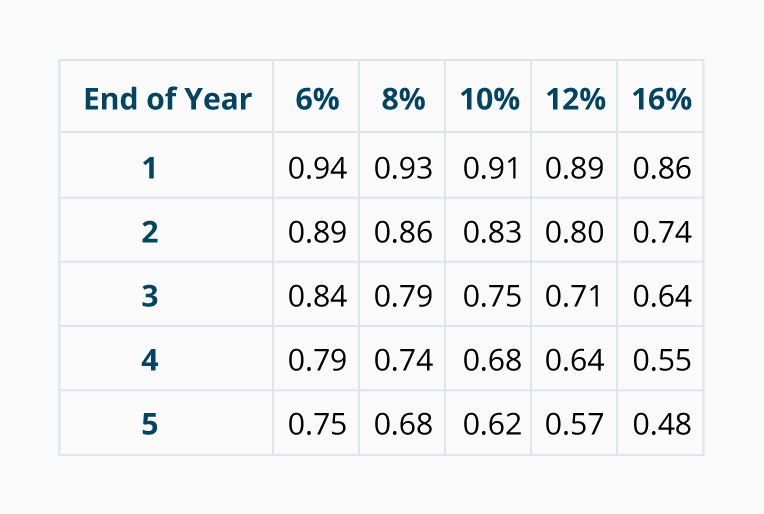
Use the following "present value of 1" factors for solving drills that require present value computations.
| End of Year |
6% |
8% |
10% |
12% |
16% |
| 1 |
0.94 |
0.93 |
0.91 |
0.89 |
0.86 |
| 2 |
0.89 |
0.86 |
0.83 |
0.80 |
0.74 |
| 3 |
0.84 |
0.79 |
0.75 |
0.71 |
0.64 |
| 4 |
0.79 |
0.74 |
0.68 |
0.64 |
0.55 |
| 5 |
0.75 |
0.68 |
0.62 |
0.57 |
0.48 |
| 5. |
A company is planning to invest $100,000 in order to receive $50,000 one year later, $40,000 two years later, and $60,000 three years later. Using the present value of 1 factors for 16% (see above), the net present value of this investment is |
|
($11,000)
$11,000
$100,000
$111,000
|
| 6. |
A $100,000 investment will be made on January 1. The cash generated from this investment is expected to be received uniformly during each year. The yearly amounts are: $50,000 in the first year; $40,000 in the second year; $60,000 in the third year. What is the expected payback period? |
|
2.0 years
2.1 years
2.17 years
3 years
|
| 8. |
Depreciation Expense is a negative cash flow that needs to be discounted. |
True |
False |
| 9. |
While depreciation does not result in a payment of cash, tax depreciation does reduce the cash payments for income taxes. |
True |
False |
| 10. |
Depreciation Expense can be ignored when computing the accounting rate of return. |
True |
False |
| 11. |
If the net present value of a project is $0, the project should be rejected. |
True |
False |
| 12. |
A project whose future cash flows are discounted by 10% will have a larger net present value than the same cash flows discounted by 8%?
|
True |
False |
| 13. |
What amount would you invest today in return for a one-time $10,000 receipt one year from today, if you want to earn 8%? (Use the factors above.) |
|
$9,200
$9,300
$9,920
|
| 14. |
How much would you invest today in return for $20,000 to be received two years from today, if you want to earn 10%? (Use the factors above.) |
|
$16,000
$16,600
$18,260
|
| 15. |
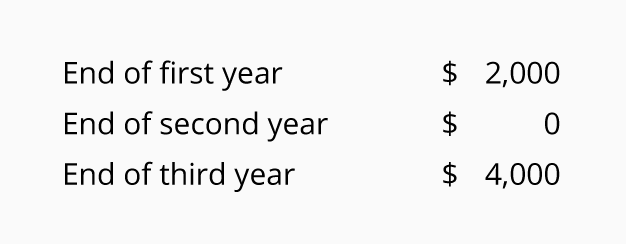
A potential investment today will provide all of the following cash receipts
| End of first year | $2,000 |
| End of second year | $ 0 |
| End of third year | $4,000 |
If you want to earn a 12% internal rate of return, how much would you invest today to receive these cash amounts? (Use the factors above.)
|
|
$4,260
$4,620
$4,980
|
| 16. |
If you invest $68,000 today and get repaid $100,000 at the end of five years, what is the internal rate of return on your investment? (Use the factors above.) |
|
6%
8%
10%
12%
16%
|
| 17. |
If you invest $15,900 today and receive $10,000 at the end of one year plus $10,000 at the end of four years, what is the internal rate of return on your investment? (Use the factors above.) |
|
6%
8%
10%
12%
16%
|
| 18. |
If you invest $15,300 today and receive $10,000 at the end of one year and $10,000 at the end of four years, what is the internal rate of return on your investment? (Use the factors above.) |
|
6%
8%
10%
12%
16%
|
| 19. |
You invest $10,000 immediately plus an additional $100,000 at the end of one year. If the time value of money is 10%, what is the present value of your investment? (Use the factors above.) |
|
$100,000
$101,000
$110,000
|
| 20. |
The state lottery offers a $500,000 prize consisting of $100,000 immediately and then four annual payments of $100,000 each. If the winner prefers to receive an immediate lump sum, the state discounts the future payments by 6%. What will be the immediate lump sum amount before any taxes? (Use the factors above.) |
|
$346,000
$400,000
$446,000
$470,000
|