Course Outline
Join PRO
Dark Mode
Join PRO to View Coaching

Depreciation (Word Scrambles with Coaching)

Author:
Harold Averkamp, CPA, MBA

To see each answer, press or click the blue "Unscramble" button. For a short description and example, press or click the “View Coaching” button. If you have difficulty answering the following questions, read our In-Depth Explanation for this topic.

1. Depreciation achieves this principle.

MATCHING HGTAINMC
MATCHING CMGNTHAI
Unscramble

Depreciation entries are associated with the matching principle or expense recognition principle which requires that expenses be reported on the income statement in the same period as the related revenues or when costs are used up.

Example: Equipment with a cost of $140,000 is expected to be useful for 7 years. Therefore, the company will report Depreciation Expense of $20,000 each year for 7 years.

2. Another name for book value is _________ value.

CARRYING ICNRGRYA
CARRYING AICGRNYR
Unscramble

Another name for book value is carrying value. Book value or carrying value of an asset used in a business is the asset’s cost minus its accumulated depreciation.

Example: If equipment had a cost of $100,000 and its accumulated depreciation is $30,000, the equipment’s carrying value or book value is $70,000.

3. When an asset is depreciated using the _____________-line method, the annual depreciation expense will be the same amount in most years.

STRAIGHT ASITGRHT
STRAIGHT ARTSIHTG
Unscramble

When an asset is depreciated using the straight-line method, the annual depreciation expense will be the same amount each full year over the asset’s estimated useful life.

Example: A $50,000 asset with a 5-year useful life and no salvage value will have straight-line depreciation expense of $10,000 per year for 5 years.

4. ______________ Depreciation is the balance sheet account.

ACCUMULATED LCAMUECTDAU
ACCUMULATED ETUMCALCUAD
Unscramble

Accumulated depreciation is a balance sheet contra asset account. It reports the total amount of depreciation expense reported from the date the asset was acquired (and put into service) until the date of the balance sheet.

Example: If equipment has depreciation expense of $20,000 per year, after 3 years its accumulated depreciation account will have a credit balance of $60,000.

5. This type of depreciation results in more depreciation in an asset's earlier years and less in its later years.

ACCELERATED RCDEAELATCE
ACCELERATED ELRETCCDAAE
Unscramble

Accelerated depreciation methods, such as double-declining balance or sum-of-the-years’- digits, result in more depreciation expense in the early years of an asset’s life and less depreciation expense in the later years (compared to the straight-line method).

Example: An asset with a cost of $100,000, 5-year life, and no salvage value could have depreciation of $40,000, $24,000, $14,400, $10,800, and $10,800 in years 1through 5 under the double-declining balance method instead of a constant $20,000 a year using straight-line depreciation.

6. Depreciation is an ___________ process not a valuation process.

ALLOCATION IOCALLOTAN
ALLOCATION LCANATLOIO
Unscramble

Depreciation is an allocation process, not a valuation process. It systematically allocates (or assigns) the cost of an asset to expense over its useful life in a systematic manner.

Example: A building costing $2,000,000 with a 40-year useful life will have $50,000 of depreciation expense each year, even though the building’s market value could be increasing.

7. This long-term asset is not depreciated.

LAND LADN
LAND ANLD
Unscramble

Land is a long-term asset that is not depreciated. Only assets with limited useful lives are depreciated. (Land is assumed to have an unlimited life.)

Example: If a company buys a property for $500,000, consisting of a building valued at $350,000 and land valued at $150,000, only the $350,000 building cost will be depreciated over its useful life. The $150,000 land cost is not depreciated.

8. An asset's cost minus its accumulated depreciation is its book ________.

VALUE LEVAU
VALUE AUELV
Unscramble

An asset’s book value is the asset’s cost minus its accumulated depreciation. Book value is also known as the asset’s carrying value, since this is the amount in the general ledger accounts and reported on the balance sheet.

Example: Equipment with an original cost of $80,000 and accumulated depreciation of $50,000 will have a book value or carrying value of $30,000.

9. Depreciation for income tax reporting can be different from depreciation for ____________ reporting.

FINANCIAL FALIANCNI
FINANCIAL INLCIFAAN
Unscramble

Depreciation expense reported on a company’s income statement often differs from depreciation expense reported on the company’s tax return. Companies frequently use straight-line depreciation for its financial statements but accelerated depreciation for tax reporting.

Example: On its income statements, a U.S. corporation likely reports straight-line depreciation expense on a $300,000 machine with a 10-year life. On its tax return, the company uses an accelerated 5-year depreciation schedule, giving it higher tax depreciation expense in the early years. However, over the life of an asset the total amount of depreciation under any method cannot exceed the asset’s cost

10. Another term for residual value or scrap value is _________ value.

SALVAGE LAEAVSG
SALVAGE LEGSAVA
Unscramble

The salvage value is also known as residual or scrap value. It is the estimated amount a company expects to receive when disposing of an asset at the end of its useful life. Salvage value is subtracted from an asset’s cost when determining the total amount to be depreciated.

Example: If a $100,000 asset has an estimated $10,000 salvage value, only $90,000 will be depreciated over the asset’s useful life. The $10,000 estimated salvage value is not depreciated.

Access 1,800+ Premium Test Questions

Get Our Premium Depreciation Test Questions When You Join PRO

Receive instant access to our entire collection of premium materials, including our 1,800+ test questions.

View All PRO Features

Features

Free

PRO

Lifetime Access (One-Time Fee)
Explanations
Quizzes
Q&A
Dictionary
Bookkeeping Video Training
Financial Statements Video Training
Visual Tutorials
Quick Tests
Quick Tests with Coaching
Cheat Sheets
Flashcards
Crossword Puzzles
Word Scrambles with Coaching
Bookkeeping Study Guide
Managerial and Cost Accounting Study Guide
Certificates of Achievement
Bookkeeping Certificate of Excellence
Business Forms
Printable PDF Files
Progress Tracking
Motivational Badges and Points
Motivational Medal Rankings
Motivational Activity Streaks
Public Profile Page of Achievements
Dark Mode

About the Author

Harold Averkamp

For the past 52 years, Harold Averkamp (CPA, MBA) has
worked as an accounting supervisor, manager, consultant, university instructor, and innovator in teaching accounting online. He is the sole author of all the materials on AccountingCoach.com.

Learn More About Harold

Read 3,034 Testimonials

PRO for Teams
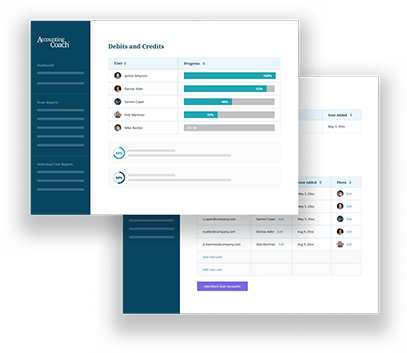
  • Easily add new users and team admins
  • Monitor individual user progress and grades
  • Monitor team progress and compare users
  • View average grades and find problem areas
  • Monitor recent activity and user achievements
PRO for Teams
Take the Tour Join PRO